
The Unicorn Tears Problem
How a quantum computer helped crack fusion's tritium crisis — and a 110-kilocalorie mistake revealed why nature refuses to be chopped into pieces
Salt bath dreams of stars—
sliced too fine, the whole slips through:
electrons still touch.
With every article and podcast episode, we provide comprehensive study materials: References, Executive Summary, Briefing Document, Quiz, Essay Questions, Glossary, Timeline, Cast, FAQ, Table of Contents, Index, Polls, 3k Image, Fact Check, Comic and
Street Art at the very bottom of the page.
Soundbite
Trailer
Essay
Everything Is Talking to Everything Else and We Cannot Afford to Forget It
Let’s start with the number that should make you sit up straight: twenty-five kilograms. That’s the entire global stockpile of tritium — the radioactive fuel a fusion reactor needs to actually work — sitting in vaults around the planet right now. You could fit it in a suitcase. Meanwhile, a single commercial fusion plant, the kind we’re promising will save civilization, would burn through half a kilogram of the stuff every day. Do the math and you get fifty days before humanity’s entire tritium supply is gone, and that’s assuming nobody else wants any.
This is the part of the fusion story nobody puts on the inspirational poster. We love talking about magnetic bottles and the temperature of the sun and how fusion produces no long-lived radioactive waste, unlike its unfortunate cousin fission. What we don’t love talking about is that the “clean unlimited energy” of the future currently runs on a fuel so scarce it might as well be harvested from unicorns.
So the reactor has to make its own. That’s the whole premise of the “blanket” — a thick jacket of molten salt called FLIBE, wrapped around the plasma core, catching the neutrons that fly out of the fusion reaction and using them to breed new tritium on the spot. It’s an elegant idea. It is also, chemically speaking, an absolute nightmare, because once that fresh tritium is born inside a thousand-degree radioactive soup of fluorine, lithium, and beryllium, it doesn’t just sit there waiting politely to be collected. It bonds. It hides. It gets sandwiched between fluorine atoms in configurations so subtle that classical supercomputers — the biggest, fastest machines humanity has ever built — cannot calculate them with the precision engineers need.
This is where the story gets interesting, and where I want to gently push back on the way we usually tell it.
The convenient narrative is: quantum computers are magic, classical computers are obsolete, here comes the future. That’s not what happened at Oak Ridge National Laboratory and IBM Quantum this July. What happened was more honest, and frankly more useful, than a magic trick. Scientists took a technique originally built to understand a 12,635-atom protein at the Cleveland Clinic — yes, a hospital, co-authoring a fusion physics paper, because it turns out the mathematics of a folding protein and the mathematics of a fluorine ion refusing to let go of a tritium atom are, at the level electrons operate on, the same math — and pointed it at a miniature star instead of a human body.
They built what amounts to a kitchen. A classical supercomputer, playing head chef, handled the bulk of the simulation: hundreds of atoms, the overall shape of the chaos. But for the one delicate reduction sauce that required molecular perfection — the razor-thin quantum correlations between fluorine’s squishy electron cloud and a newly formed tritium ion — they handed the dish to a sous chef: an IBM quantum processor, taking a million measurements a second and letting nature’s own randomness find the answer, the way rain finds the lowest point in a mountain range without anyone walking it.
And it worked. Spectacularly. Across nine different molecular clusters, the quantum hardware matched the gold-standard classical answer to within seven-tenths of a kilocalorie per mole — inside the threshold that chemists call “chemical accuracy,” the line between a design that works and one that quietly fails in a billion-dollar reactor. This is, by the authors’ own account, the first time anyone has pulled this off for a charged ionic system in a molten salt. That’s not a small thing. That’s a machine doing real chemistry that the world’s fastest classical computers genuinely could not do.
Here’s the part I find myself sitting with, though, and it’s where the story turns from a triumph into something wiser.
When the scientists reassembled all those perfectly solved fragments back into the whole molecule, the total answer was off — not by a little, but by 110 kilocalories per mole. A catastrophic error, on paper. Except the quantum computer hadn’t made a mistake. Every fragment it was handed, it solved beautifully. The error lived somewhere else entirely: in the act of chopping the problem up in the first place. To make the math small enough to compute at all, the researchers had drawn an artificial boundary around each fragment — a line that said, essentially, we will only pay attention to the electrons close enough to matter, and ignore everything past it. But in a fluid this interconnected, nothing is really past it. The distant electrons were still gently pushing and pulling on the near ones, the way two water balloons in the same pool nudge each other without ever touching. Slice the liquid into isolated pieces and you lose those long-range ripples. You get each piece right and the whole wrong.
I don’t think this is a story about quantum computers failing. I think it’s a story about the particular, very human comfort of believing a system can be understood by breaking it into parts and studying each part in isolation — and the quietly humbling discovery, again, that reality rarely consents to be studied that way. We do this everywhere, not just in chemistry: we chart the individual, the department, the transaction, the single data point, and hope the sum of our careful little X-rays adds up to the whole jagged, glowing picture. Sometimes it does. Often, something is lost in the seams.
The genuinely hopeful part, and I want to end here rather than in the murk, is what the scientists did with that failure. They didn’t throw out the quantum approach. They didn’t declare fusion computing a dead end. They pinpointed, with real precision, exactly where the blind spot lived — in the fragmentation, not the hardware — and they’re now teaching AI systems to draw smarter boundaries, ones that preserve the whisper of connection between distant atoms instead of severing it. The hardware, they now know, is ready. The intelligence being built to wield it more wisely is catching up.
There’s something almost tender in that. A thousand-degree radioactive salt bath teaching us, gently and at enormous expense, that everything is more entangled than our tools were built to admit — and that the next real leap forward might not be a bigger machine, but a better way of paying attention to the whole.


Link References
Quantum Computations on Fusion Blanket Molten Salts
Episode Links
🍎 Apple
▶️ YouTube
🎵 Spotify
🎧 Listen
📖 Read
📻 Available for Broadcast on PRX
Other Links to Heliox Podcast
YouTube
Substack
PRX ( Public Radio Exchange)
Podcast Providers
Spotify
Apple Podcasts
Patreon
FaceBook Group
STUDY MATERIALS
Executive Summary
On July 6, 2026, a collaborative team from Oak Ridge National Laboratory, Cleveland Clinic, and IBM reported the first successful quantum computer simulations of fusion energy materials. The study utilized a heterogeneous quantum–classical workflow to model FLiBe (2LiF–BeF2), a molten salt critical for breeding tritium fuel in fusion reactors.
The breakthrough addresses the “tritium bottleneck”—the necessity of producing and recovering approximately 0.5 kg of tritium per day for a 1 GW reactor. Using IBM’s Heron r3 processor, researchers achieved ground-state energy accuracy within 0.7 kcal/mol of full configuration interaction (FCI) references. This work represents a primary milestone for the U.S. Department of Energy’s Genesis Mission and demonstrates the transferability of quantum algorithms from biological protein simulations to inorganic ionic systems. While the quantum solvers proved highly accurate, the study identified fragment construction (embedding) as the dominant source of algorithmic bias, setting a clear trajectory for future high-fidelity free-energy simulations.
Technical Analysis: Quantum Simulations of FLiBe
The Material Challenge: FLiBe Molten Salt
FLiBe is a leading candidate for fusion reactor “blankets” designed to breed tritium (3H or T). When struck by neutrons from the plasma core, the 6Li isotope in the salt fragments into 4He and a tritium ion.
Speciation Complexity: Tritium interacts differently based on its form; neutral T2 diffuses rapidly due to weak interactions, while ionic T+ binds tightly to fluoride ions, often forming multi-center F-T-F bonds.
Computational Difficulty: The ionic nature of FLiBe, featuring high fluoride polarizability and fluctuating structural orders, makes electronic correlation treatment challenging for classical density functional theory (DFT), which often exhibits error levels (~10%) that limit predictive capability.
Heterogeneous Quantum–Classical Workflow
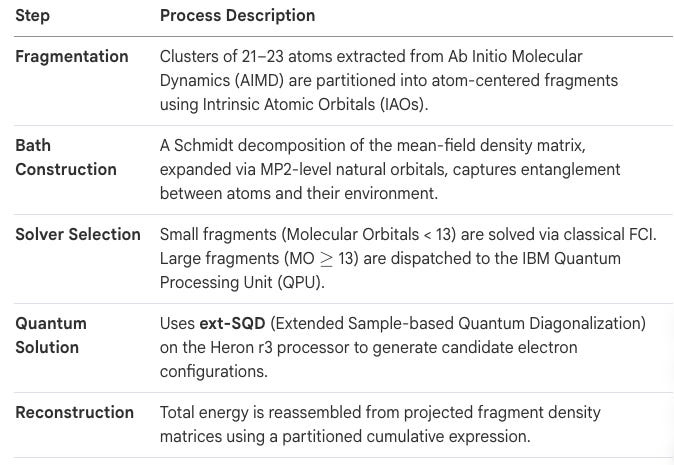
The project employed an Embedded Wave Function (EWF) method to partition complex clusters into manageable fragments.
Performance Benchmarks and Hardware
The largest fragment treated (33 molecular orbitals) utilized a 66-qubit circuit on the ibm_boston processor.
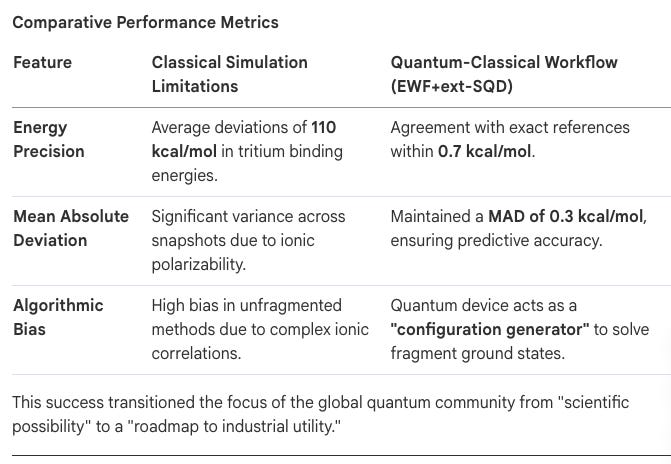
Accuracy: The ext-SQD solver matched classical FCI to a mean absolute deviation of 0.3 kcal/mol across nine clusters.
Circuit Scaling: Two-qubit gate counts scaled quadratically with fragment orbital count.
Energy Offsets: Quantum-generated absolute energies were approximately 2.1 to 2.9 kcal/mol higher than FCI due to device noise, but this offset remained constant across clusters, allowing for accurate relative energy calculations.
Strategic and Legislative Context
The Genesis Mission
This research is a key component of the U.S. Department of Energy’s Genesis Mission. The program seeks to integrate:
Exascale Computing: Modeling bulk behaviors via classical GPUs.
Artificial Intelligence: AI agents for screening candidate materials and optimizing quantum circuits.
Quantum Architectures: Calculating the most challenging atomic-level electronic correlations.
National Quantum Initiative (NQI) Reauthorization
The legislative environment in 2026 reflects a shift from basic laboratory research toward commercialization and supply chain resilience.
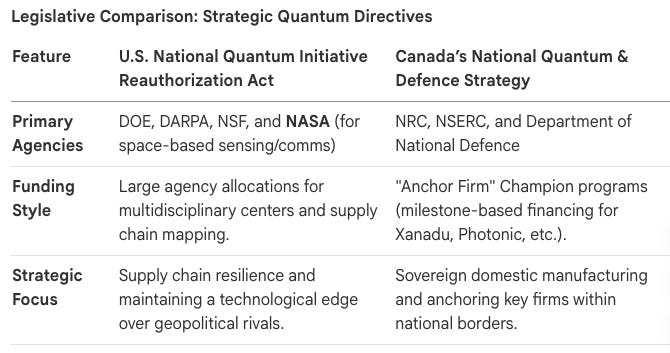
U.S. Strategy (H.R. 8462 / S. 3597): Extends the NQI framework through 2034. It formally integrates NASA into the initiative for space-based quantum sensing and tasks the Department of Commerce with mapping global supply chains to protect domestic industry.
Canadian Strategy: Operates the Canadian Quantum Champions Program (CQCP), a $92 million CAD initiative designed to rival U.S. DARPA programs by funding domestic “anchor” firms (e.g., Xanadu, Photonic) to build scalable, fault-tolerant systems.
Infrastructure and Industry Roadmaps
Hybrid Supercomputing Platforms
Hewlett Packard Enterprise (HPE) is collaborating with partners including Intel, Rigetti, and Quantinuum to build unified hybrid platforms. These testbeds focus on:
Interoperability: Aligning communication across standard High-Performance Computing (HPC) and quantum networks.
Hardware Diversity: Integrating various modalities, including silicon spin qubits, ion traps, and neutral atoms.
Quantum Hardware Roadmaps
Major providers have outlined specific milestones for reaching commercial utility in chemistry and AI applications.
D-Wave Gate-Model Roadmap:
2026–2028: Transition from 17-qubit systems to 181-qubit systems with a 2,000x error reduction.
2030–2032: Target of 100 logical qubits and over one million operations using a dual-rail superconducting architecture designed for hardware-level error detection.
Conclusions and Future Directions
The FLiBe study confirms that current quantum hardware and ext-SQD solvers are sufficiently accurate for fragment-level ground-state calculations. However, significant work remains to achieve “predictive free-energy simulations” required for reactor design:
The Embedding Gap: The study found an offset of approximately 110 kcal/mol in tritium binding energies between fragmented and unfragmented methods. This indicates that fragment construction (embedding), rather than the solver, is the primary source of error.
Scaling: Future efforts must increase cluster sizes toward the thermodynamic limit (100+ atoms) and utilize more extensive basis sets.
AI Integration: Machine-learned interatomic potentials and AI-driven “deadwood” configuration removal are proposed to accelerate configurational sampling and improve the accuracy-cost tradeoff.
Quiz & Answer Key
Instructions: Answer the following ten questions in 2-3 sentences each.
What is the role of FLiBe (2LiF–BeF2) in a nuclear fusion reactor?
Why is “tritium speciation” a critical challenge for the success of commercial fusion energy?
Explain the function of the Embedded-Wavefunction (EWF) method within the research workflow.
What was identified as the primary source of algorithmic bias in the FLiBe simulations?
Describe the technical purpose of the “ext-SQD” method used on IBM quantum hardware.
What are the primary shifts in focus for the U.S. National Quantum Initiative Reauthorization Act of 2026 compared to its 2018 predecessor?
What is the “Genesis Mission,” and how does it integrate different computing architectures?
How does the Canadian “Quantum Champions Program” (CQCP) differ from traditional funding models?
Describe the milestones of D-Wave’s gate-model roadmap leading to 2032.
In the context of the hybrid quantum supercomputing platform, what roles do partners like Riverlane and Qblox play?
Answer Key
FLiBe’s Role: FLiBe serves as a “blanket” material surrounding the fusion plasma core. When hit by energetic neutrons from the fusion reaction, the 6Li isotope within the salt fragments to “breed” tritium fuel, which is essential for sustaining the power reaction.
Tritium Speciation: Predicting how tritium exists and binds within the salt is vital for its recovery and re-insertion into the plasma. Research shows that ionic tritium (T+) binds strongly to fluoride ions, while neutral tritium (T2) diffuses much faster, making accurate electronic ground-state calculations necessary to optimize extraction.
EWF Method: The EWF method is a quantum fragmentation scheme that partitions a complex molecular system into atom-centered fragments and their local environments (bath orbitals). This allows each fragment to be solved independently by a correlated solver before the contributions are recombined to determine the global total energy.
Source of Bias: The study found that fragmentation and fragment construction (specifically bath truncation settings) were the dominant sources of error, differing by 12–110 kcal/mol from unfragmented methods. In contrast, the quantum solver itself reproduced ground-state energies within 0.7 kcal/mol of classical references, suggesting the solver is already highly accurate.
ext-SQD Method: Extended sample-based quantum diagonalization (ext-SQD) uses a quantum processor as a configuration generator to identify relevant electron configurations. Classical post-processing then diagonalizes a compact Hamiltonian in that subspace and augments it with single excitations to refine ground-state energy and density matrix estimates.
U.S. Legislative Shifts: The 2026 reauthorization pivots aggressively from basic laboratory research toward commercialization, supply chain resilience, and national defense. It also formally integrates NASA into the initiative for space-based quantum sensing and satellite communications.
Genesis Mission: This U.S. Department of Energy program aims to combine exascale computing, AI, and quantum architectures to solve high-priority energy challenges. It utilizes AI agents for material screening, GPUs for modeling bulk behavior, and quantum systems for calculating precise atomic interactions.
Canadian CQCP: Instead of spreading small grants across many institutions, the CQCP provides large, milestone-based, non-repayable funding to “anchor” domestic firms like Xanadu and Nord Quantique. This strategy is designed to build a scalable, fault-tolerant quantum industry within Canada to rival initiatives like DARPA.
D-Wave Roadmap: Between 2026 and 2028, D-Wave targets a progression from 17 to 181 physical qubits with massive error reduction. By 2030–2032, they aim to reach 100 logical qubits capable of over one million operations for commercial AI and chemistry applications.
Hybrid Platform Roles: In the Hewlett Packard Enterprise (HPE) unified platform, Qblox and Quantum Machines provide scalable control electronics. Riverlane contributes the cross-ecosystem error correction layer, ensuring interoperability between classical supercomputers and various quantum hardware modalities.
Essay Questions
Instructions: Use the provided source context to develop detailed responses to the following five prompts.
The Physics of Molten Salts: Discuss the specific electronic and structural challenges that make FLiBe molten salts difficult to model using classical density functional theory (DFT), and how the EWF-ext-SQD workflow addresses these challenges.
Quantum Policy and Geopolitics: Examine how the 2026 quantum strategies of the United States and Canada reflect a shift toward “technological edges” and “supply chain defense” in the face of global competition.
The Path to Predictive Free-Energy Simulations: Based on the “Outlook” section of the fusion study, identify the necessary advancements in cluster size, basis sets, and AI integration required to achieve high-accuracy tritium speciation models.
Hardware Diversity in Hybrid Computing: Analyze the strategic importance of HPE’s collaboration with multiple hardware partners (e.g., Intel, Rigetti, QuEra) and how these various modalities (silicon spin, superconducting, neutral atoms) contribute to a full-stack supercomputing platform.
Post-Quantum Cryptography and National Security: Evaluate the mandates for PQC migration in the U.S. and Canada, focusing on the timelines and the broader implications for protecting federal IT infrastructure.
Glossary of Key Terms
AIMD
Ab initio molecular dynamics; simulations that use quantum mechanical forces to model the movement of atoms over time.
Blanket Material
A substance (like FLiBe) surrounding a fusion reactor’s core used to capture neutrons and breed tritium fuel.
DLPNO-CCSD(T)
Domain-based local-pair natural-orbital coupled-cluster theory; a high-fidelity classical benchmark method for electronic structure.
DMET
Density-matrix embedding theory; a framework for partitioning a large quantum system into a smaller fragment and an entangled “bath.”
ext-SQD
Extended sample-based quantum diagonalization; a hybrid quantum-classical algorithm for finding ground-state energies of molecular fragments.
FLiBe
A molten salt mixture of lithium fluoride (LiF) and beryllium fluoride (BeF2) used in fusion and fission reactors.
Genesis Mission
A DOE initiative combining exascale computing, AI, and quantum systems for energy material discovery.
IAO
Intrinsic Atomic Orbitals; a localized one-particle basis that provides a chemically meaningful partition of molecular electronic structure.
LUCJ
Local unitary cluster Jastrow; a parameterized quantum circuit ansatz used to prepare correlated electronic states on hardware.
MLFF
Machine learning force field; an AI-driven model that reproduces DFT-level atomic forces at a much lower computational cost.
PQC
Post-quantum cryptography; cryptographic methods designed to be secure against decryption by future quantum computers.
Tritium (T)
A rare, radioactive hydrogen isotope used as fuel in nuclear fusion reactions.
Vayesta
A software package used for performing embedded-wavefunction (EWF) calculations.
Cast of Characters
1. The Chemical Protagonists: Primary Actors in the FLiBe Blanket
As the Principal Architect of this system, I view the realization of commercial fusion not merely as a physics challenge, but as a crisis of stoichiometric breeding ratios. To sustain a 1 GW reactor, we must produce and recover approximately 0.5 kg of tritium per day—a staggering requirement given the current global stockpile of only ~25 kg. The molten salt “blanket” is the physical bottleneck of this cycle. We must solve the problem of tritium speciation within these salts to ensure efficient recovery. If the chemical environment binds tritium too tightly, the fuel cycle breaks; if we cannot predict its behavior with sub-1% error, the industrial strategy for net-energy fusion fails.
FLiBe (2LiF–BeF₂): The primary candidate for high-magnetic-field blankets. Its dual-use utility in both fusion breeding and small modular fission reactors makes it the strategic center of high-energy-density materials research.
Tritium (T⁺): The rare hydrogen isotope and essential fuel. Its scarcity dictates that breeding efficiency within the salt is the non-negotiable “So What?” of the entire energy transition.
Lithium (⁶Li): The precursor isotope. Upon neutron impact, it fragments into ⁴He and the tritium ion, initiating the breeding sequence.
Beryllium (Be²⁺): The structural anchor forming tetrahedral complexes. Crucially, beryllium acts as a strategic reducing agent. By converting ionic tritium (T⁺) to neutral species (T₂), it facilitates faster diffusion and weaker salt interaction, which is the primary driver for recovery efficiency.
Fluorine (F⁻): A high-polarizability anion responsible for long-range dispersion and the formation of complex, multi-center F-T-F bonds. These dynamic correlations represent the “modeling wall” where classical methods traditionally fail.
While these chemical entities define the physical constraints, mastering them requires a transition from the laboratory bench to the architectural precision of quantum-centric supercomputing.
2. The Algorithmic Architects: The Workflow Orchestrating the Simulation
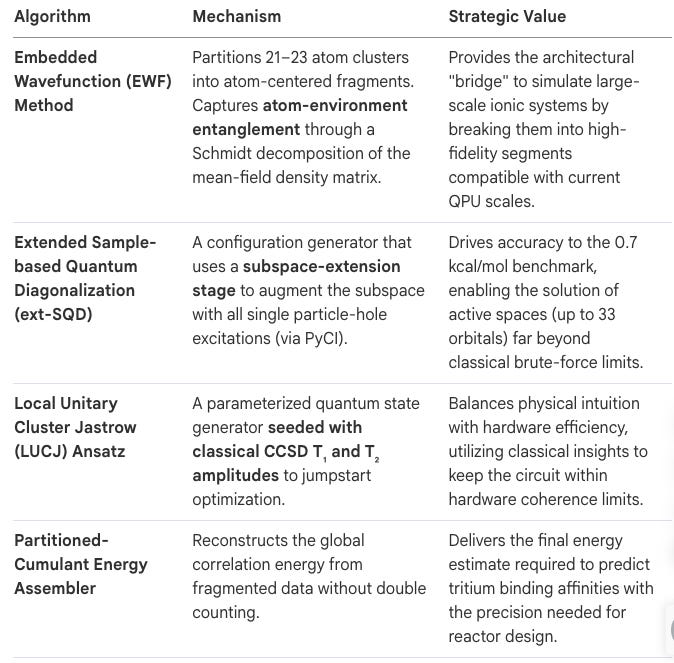
Traditional Density Functional Theory (DFT) is architecturally insufficient for this mission, typically yielding errors of 10% or higher. For the Genesis Mission, we require “chemical accuracy” (<1 kcal/mol), necessitating a hybrid workflow that partitions the complexity of the salt into manageable, high-fidelity fragments.
Algorithmic Differentiators: Mechanism vs. Strategic Value
This algorithmic orchestration relies on a computational stage capable of executing these diverse modalities at exascale.
3. The Computational Stage: Hardware Modalities and Global Infrastructure
We have moved beyond the era of the standalone quantum computer into the “Quantum-Centric Supercomputing” paradigm. Here, the QPU handles the finest electronic correlations—the “hard” fragments—while the GPU/CPU fabric manages the bulk environment and classical post-processing.
IBM Heron r3 (ibm_boston): The 130-qubit primary quantum engine. For the July 2026 breakthrough, it executed 66-qubit circuits (M=33) to model the most complex fluorine-centered fragments, utilizing a heavy-hex layout to mitigate hardware noise.
Frontier (OLCF): The “ground truth” reference. This exascale system performed Full Configuration Interaction (FCI) benchmarks using 3,840 AMD MI250X GPUs across 480 nodes. This contrast—quantum efficiency versus classical brute force—validates the quantum advantage in fragment solution.
HPE Cray Infrastructure: The unifying platform for the “Quantum Supply Chain.” It integrates diverse modalities (Intel, IQM, Rigetti) into a unified, full-stack hybrid platform, ensuring interoperability across partner hardware.
The technical infrastructure is supported by a shift in geopolitical strategy, moving research from the ivory tower to the industrial front line.
4. The Geopolitical Producers: Legislative and Institutional Stakeholders
The FLiBe breakthrough is a cornerstone of the Genesis Mission, signaling a shift from basic science to a comprehensive commercial and defense industrial strategy. This mission treats quantum capability as a pillar of national security and clean energy sovereignty.
A vital strategic accelerator has been the partnership between the Cleveland Clinic and Oak Ridge National Laboratory (ORNL). By adapting protein-scale embedding techniques—originally used for 12,635-atom biological simulations—to nuclear materials research, we have achieved a “cross-domain tech transfer” that collapsed the Discovery Cycle for fusion salts by years. This inter-allied cooperation is essential for securing the quantum supply chain among trusted democratic partners.
5. Summary of the Ensemble: Achieving Chemical Accuracy
The collective effort of this ensemble has achieved a landmark benchmark: reproducing fragment ground-state energies with an accuracy of 0.7 kcal/mol (ext-SQD versus FCI). This confirms that our quantum solvers are now “accurate enough” for the mission. However, our analysis has revealed the new primary bottleneck: the “Embedding Gap” (or Fragmentation Bias).
The ~110 kcal/mol offset observed in absolute binding energies is a signature of the fragment construction architecture, not the solver quality. The next stage of the Discovery Cycle must move toward “chemically aware strategies,” increasing fragment sizes and lowering the fragmentation threshold (η) to bridge this gap.
Ultimately, this cast of characters has positioned the U.S. and its allies to dominate the race for net-energy fusion. By mastering the quantum speciation of FLiBe, the Genesis Mission is creating a sovereign domestic manufacturing advantage that will define the era of sustainable, secure fusion power.
Timeline of Main Events
1. The Precursory Phase: Institutional Expiry and Early Biological Proofs (Late 2023 – Early 2026)
This period marks the critical strategic pivot from abstract theoretical exploration to mission-oriented industrial application. As the first wave of quantum research reached maturity, the focus shifted toward resolving specific, high-value bottlenecks in materials science. The demonstration that quantum-centric supercomputing could accurately model massive biological systems provided the foundational “technology transfer” necessary for energy infrastructure. By proving that quantum processors could handle the intense electronic correlations of active molecular sites while classical systems modeled the bulk environment, researchers established a validated workflow that would later be repurposed for the high-temperature, ionic complexities of zero-carbon fusion.
Chronological Foundations
Late 2023: The original 2018 National Quantum Initiative Act officially expires. This creates a legislative vacuum that shifts the subsequent policy focus toward commercialization, supply chain resilience, and sovereign defense.
Early 2026: IBM and the Cleveland Clinic announce a milestone in biological simulation, successfully modeling protein structures consisting of 12,635 atoms. This achievement validates the “Embedded Wavefunction” (EWF) method at scale.
The Biological Blueprint for Materials Science
The simulation of massive proteins served as a functional blueprint for subsequent fusion research. By utilizing the EWF approach, researchers demonstrated the ability to partition complex systems into atom-centered fragments. This methodology allowed for a hierarchical division of labor: quantum processors were reserved for the most challenging electronic correlations, while classical high-performance computing (HPC) handled the surrounding environment. This effectively “de-risked” the chemical modeling process before its application to the highly polarized ionic environment of fusion blanket salts, providing the scientific momentum needed for a massive North American legislative response.
2. The Legislative Pivot: From Laboratory Research to Sovereign Security (Late 2025 – 2026)
Western quantum policy underwent a structural shift in late 2025, moving away from basic science toward the hardening of domestic supply chains and the pursuit of geopolitical advantage. This period solidified quantum technology as a pillar of national security, focusing on protecting against “Harvest Now, Decrypt Later” strategies employed by adversarial states.
Dual-Track North American Timelines
The United States Track
Early 2026: Launch of the National Quantum Initiative Reauthorization Act (S. 3597 and H.R. 8462). The bill pivots toward supply chain defense and explicitly aims to maintain a technological edge in the race for fault-tolerant systems.
NASA Integration: For the first time, NASA is formally added to the initiative, leading R&D in space-based quantum sensing and satellite-based quantum communications.
DARPA Mandate: The legislation requires DARPA to move beyond theoretical benchmarks and begin measuring the real-world performance of emerging quantum applications.
The Canadian Track
Late 2025: Launch of the Canadian Quantum Champions Program (CQCP) with a $92M initial phase. This program focuses milestone-based funding on domestic “anchor firms” like Xanadu and Nord Quantique to ensure the industrial base remains sovereign.
Budget 2025 Pivot: Implementation of a 900MDefenceIndustrialStrategy,with∗∗334M** earmarked specifically to anchor quantum technology to national defense requirements.
Synthesis: The Global Race for Quantum PNT
A critical strategic intersection emerged between the US and Canadian tracks: the race for Quantum Positioning, Navigation, and Timing (PNT). While the U.S. expanded NASA’s role to focus on space-based sensing, Canada funneled defense funding into the National Research Council (NRC) to develop extreme-sensitivity GPS-free navigation. These parallel efforts highlight a coordinated Allied push to ensure stealth and operational continuity in GPS-denied environments through quantum sensing. This sovereign investment provided the institutional backing required to validate the Department of Energy’s (DOE) Genesis Mission.
3. The Functional Breakthrough: Fusion Blanket Simulation (July 6, 2026)
On July 6, 2026, the DOE Genesis Mission achieved a definitive breakthrough by applying quantum computing to the primary bottleneck of commercial fusion: tritium breeding. For a reactor to be self-sustaining, it must produce its own fuel by hitting the 6Li isotope in a surrounding “blanket” with energetic neutrons, fragmenting it into 4He and a tritium ion (T+). This breakthrough allowed for the precise mapping of FLiBe (2LiF–BeF2), the leading molten salt candidate for this breeding process.
The Hybrid “Configuration Generator” Workflow
The breakthrough utilized a heterogeneous quantum-classical workflow integrating IBM’s 130-qubit Heron r3 processor (ibm_boston). Using the EWF-FCI+ext-SQD method, researchers solved the “dominant source of algorithmic bias”—the high polarizability of fluoride ions—that causes classical methods to fail.
In this hybrid division of labor, the quantum device functioned as a “configuration generator,” drawing candidate electron configurations from a parameterized quantum state. Classical post-processing then performed the final diagonalization. This approach allowed the quantum processor to focus on the finest atomic correlations of the tritium binding to the salt fragments, while classical GPUs modeled the bulk behavior of the liquid melt.
4. The Roadmap to Utility: Hardware Scaling and Security Deadlines (2026 – 2034)
The final phase of this chronology involves the alignment of fault-tolerant hardware scaling with the legal mandates required to protect national infrastructure from “Q-Day”—the moment quantum systems can compromise modern cryptographic standards.
D-Wave Gate-Model Scaling Roadmap
The trajectory toward fault-tolerance is defined by a rigorous dual-rail superconducting architecture:
2026–2028: Initial progression from a 17-qubit system (2x error reduction) to a 49-qubit system (20x error reduction), culminating in a 181-qubit system with a 2,000x error reduction.
2030: Achievement of a 10-logical-qubit system, enabling the first true fault-tolerant algorithms for chemical modeling.
2032: Deployment of 100 logical qubits and the capability for over one million operations, enabling industrial-scale simulations of fusion salts and complex catalysts.
Sovereign Security and the 2034 Buffer
Strategic policy is now dictated by Post-Quantum Cryptography (PQC) migration deadlines. Canada has legally mandated a government-wide PQC migration by 2031 to defend federal IT infrastructure.
In a mirrored strategy, the U.S. National Quantum Initiative Reauthorization Act extends its framework through December 2034. This 2034 sunset date is a calculated strategic move; it provides a two-year “security buffer” following the 2032 arrival of 100-logical-qubit systems. This window ensures that defense systems and energy grids are fully migrated to quantum-resistant standards before the hardware threshold for breaking RSA-level encryption is reached.
Summary of 2030–2032 Milestones
Initial Fault-Tolerance (2030): Deployment of 10-logical-qubit systems for refined tritium speciation modeling.
Commercial AI & Chemistry (2032): Transition to the 100-logical-qubit standard, enabling the first true “computational engine” for fusion reactor Discovery Cycles.
The Q-Day Buffer (2032–2034): A final two-year period for the mandatory migration of high-priority energy and defense infrastructure to PQC standards.
The intersection of these timelines—scientific, hardware-centric, and legislative—creates a unified path toward a quantum-ready fusion infrastructure by the mid-2030s, ensuring that the next generation of clean energy is both viable and secure.
FAQ
1. The Strategic Intersection of Quantum Computing and Fusion Energy
The announcement in July 2026 of successful quantum-centric simulations of FLiBe molten salts marks a transformative milestone for the U.S. Department of Energy’s Genesis Mission. This represents the first-ever demonstration of quantum advantage in modeling a charged ionic system—an inorganic molten salt where extreme electrostatic and polarization effects create many-body correlations that are intractable for purely classical architectures. By resolving the electronic correlation of tritiated salts, this research provides a computational path to overcoming the primary material hurdles of the fusion fuel cycle.
What is the “Tritium Breeding” bottleneck, and why does it threaten commercial fusion viability? Commercial fusion viability hinges on fuel self-sufficiency. A 1 GW fusion reactor consumes approximately 0.5 kg of tritium per day, yet the current global stockpile is a mere ~25 kg. This scarcity makes “tritium breeding”—the generation of fuel within the reactor itself—a critical requirement. Without high-fidelity modeling to optimize the recovery of tritium from blanket materials, the industry faces a terminal fuel supply gap that prevents the deployment of utility-scale power.
Why was FLiBe (2LiF–BeF2) selected as the primary target for this study? FLiBe is a leading candidate for high-magnetic-field reactors due to its excellent radiation shielding and heat transfer properties. Strategically, it serves as a breeding medium: when energetic fusion neutrons strike the lithium-6 (6Li) isotopes within the salt, they trigger a nuclear fragmentation that produces helium and tritium. Accurate modeling is required to understand the local coordination environments—specifically the transition between ionic Li–F and partially covalent Be–F networks—that govern how this bred tritium is chemically bound and eventually extracted.
How does the “Genesis Mission” framework integrate diverse computational architectures? The mission utilizes a unified, high-performance computing (HPC) stack to bridge the gap from atoms to reactors:
AI Agents: Used for active learning to generate machine-learning force fields (MLFF) and screen candidate molecular configurations.
Classical GPUs: Execute large-scale ab initio molecular dynamics (AIMD) to model bulk fluid trajectories and provide conformational snapshots.
IBM Quantum Systems: Deploy quantum-centric algorithms to solve the most complex electronic ground-state energies for localized salt fragments.
This integrated approach allows us to move beyond the limitations of Density Functional Theory (DFT) to capture the intricate electronic correlations that dictate tritium speciation.
2. Technical Architecture: The Hybrid Quantum-Classical Workflow
To make massive molecular systems (21–23 atom clusters) computationally tractable, the Genesis Mission employs the “Embedded Wavefunction” (EWF) method. This approach leverages the locality of electronic correlation in molten salts to partition a global problem into smaller, high-fidelity sub-problems.
What is the EWF method, and how does it partition complex molten salt clusters? The EWF method, rooted in density-matrix embedding theory, fragments clusters into atom-centered fragments. For each fragment, a “Schmidt decomposition” of the mean-field density matrix is used to construct bath orbitals. These bath orbitals capture the one-particle entanglement between the local atom and the rest of the salt environment, allowing for a compact but chemically accurate representation of the cluster’s electronic structure.
Explain the “ext-SQD” (extended Sample-based Quantum Diagonalization) pipeline. The pipeline utilizes the IBM Heron r3 processor to solve fragment ground states via a multi-step hybrid process:
Quantum Sampling: A Local Unitary Cluster Jastrow (LUCJ) ansatz is executed on the QPU to generate candidate Slater determinants.
Configuration Recovery: Classical post-processing mitigates hardware errors by ensuring determinants adhere to particle number and spin conservation.
Classical Diagonalization: A compact Configuration Interaction (CI) Hamiltonian is diagonalized in the quantum-identified subspace.
Subspace Augmentation: The most relevant configurations are extended through single-excitation operators to refine the ground-state energy.
Why are the “IAO” (Intrinsic Atomic Orbital) basis and 6-31+G(d) set critical? The simulations utilize a 6-31+G(d) basis set to account for the high polarizability of fluoride ions. IAOs are essential because they provide an unbiased, atom-centered partition of the occupied space, accurately reflecting the formal charges of Li+, Be2+, and F−. This basis is uniquely suited to handle the diverse bonding—from the ionic character of Li-F to the tetrahedral Be-F coordination—without the ambiguities of standard localization schemes.
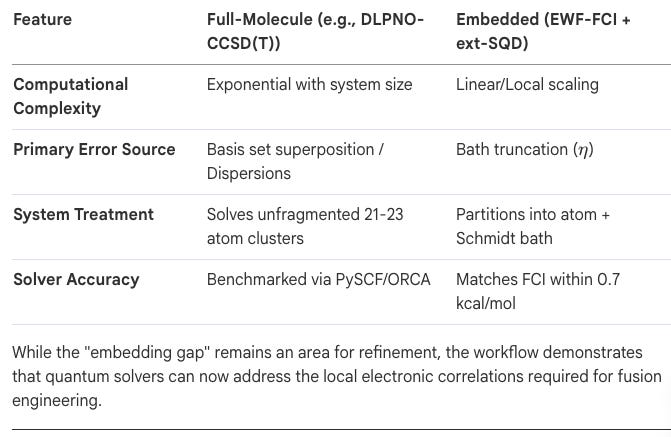
Contrast the performance of fragmented vs. unfragmented methods. The data reveals that while fragmentation is the current dominant source of bias (due to a bath truncation threshold of η=10−5), the quantum solver accurately reproduces fragment-level solutions.
3. Hardware and Scaling: The IBM Heron r3 Infrastructure
The July 2026 simulations were executed on the ibm_boston system, an IBM Heron r3 processor. This hardware is optimized for the heavy-hex connectivity required to simulate the largest fragments in the FLiBe clusters.
How does the QPU/Classical dispatch boundary work for fragment solution? The workflow employs a dual-gate selection logic to optimize resources:
Dispatch Logic: Fragments with a Number of Orbitals (NORB) < 13 are solved via classical FCI. Fragments with NORB ≥ 13 (up to 33 orbitals/66 qubits) are dispatched to the QPU.
Shot Budget Logic: Within the QPU-targeted set, fragments with NORB < 20 utilize 105 shots, while those with NORB ≥ 20 utilize 106 shots to ensure statistical convergence in larger Hilbert spaces.
What are the specifications of the LUCJ ansatz circuits? Implemented through the ffsim library, the Local Unitary Cluster Jastrow (LUCJ) ansatz utilizes a single-layer circuit (nreps=1). Crucially, parameters are seeded from classical CCSD T1 and T2 tensors, providing a high-quality starting point for the variational optimization. The two-qubit gate counts scale quadratically (M2) with orbital count (M), allowing a 33-orbital fragment to be successfully transpiled onto the Heron’s heavy-hex layout with thousands of gates while remaining within the coherence window.
How were hardware errors mitigated during the sampling process?
Dynamical Decoupling (XY4): Suppresses decoherence during gate idle times.
Measurement Twirling: Reduces systematic readout errors.
Self-Consistent Configuration Recovery: A classical post-processing loop that corrects bitstrings to maintain symmetry-compatible configurations (Sz and N conservation).
4. Benchmarking Accuracy: Solver Error vs. Embedding Bias
In molten salt chemistry, accuracy at the kcal/mol level is mandatory. Because chemical phenomena are driven by Boltzmann averages, the target precision is tied directly to the operating temperature of the breeding blanket.
Evaluate the precision of the ext-SQD solver compared to classical FCI. The ext-SQD solver achieved a mean absolute deviation (MAD) of only 0.3 kcal/mol relative to FCI. While absolute energies showed a constant offset of 2.1–2.9 kcal/mol—attributed to residual device noise and limited determinant sampling—this offset cancels in relative energy calculations. At an operating temperature of 900 K, where the Boltzmann factor kBT≈1.8 kcal/mol, the 0.7 kcal/mol solver error is well within the window required for predictive equilibrium constants.
What is the “Embedding Gap,” and why is it currently the dominant source of bias? The simulations identified an approximate 110 kcal/mol “Embedding Gap” in tritium binding energies between fragmented (EWF) and unfragmented methods. This bias stems from bath truncation (η=10−5), where the spatial localization of fragments potentially loses long-range dispersion or many-body correlations. Convergence of this embedding threshold is the primary focus for future refinements.
What are the findings regarding Tritium Speciation? The study quantified the thermodynamic differences between neutral and ionic tritium:
Neutral Tritium (T2): Interacts weakly with the molten salt, resulting in high diffusion rates.
Ionic Tritium (T+): Binds intensely to fluoride ions, often forming F–T–F motifs. Connected two-body cumulants and radial distribution functions confirm that T+ is tightly coordinated within the salt’s ionic network, setting the thermodynamic baseline for extraction protocols.
5. Policy, Legislation, and Global Competition
The technical success of the Genesis Mission is synchronized with a fundamental shift in U.S. and allied quantum policy, moving from laboratory discovery toward technological sovereignty and industrial scaling.
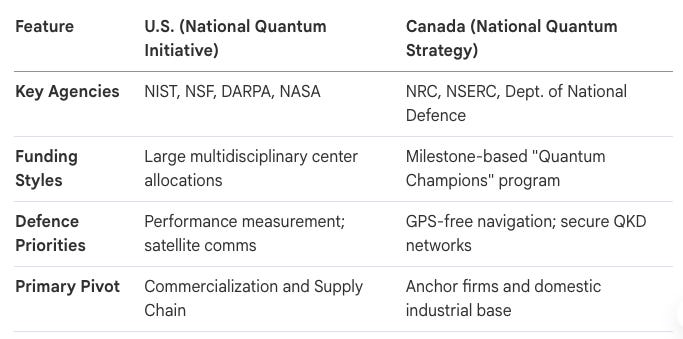
How does the National Quantum Initiative Reauthorization Act change the strategic focus? The reauthorization (S. 3597/H.R. 8462) extends the U.S. framework to 2034, pivoting aggressively toward commercialization and supply chain resilience. Key changes include the formal integration of NASA for space-based quantum communications and a mandate for DARPA to benchmark real-world application performance. This act explicitly targets geopolitical competition, directing the Department of Commerce to map global supply chains to mitigate critical foreign dependencies.
Compare the U.S. strategy with Canada’s National Quantum and Defence Strategy.
What is the mandate for “Post-Quantum Cryptography” (PQC) migration? Recognizing the threat of future “harvest now, decrypt later” attacks, both nations have issued mandates for federal IT infrastructure. Canada has set a 2031 target for the migration of high-priority systems to PQC standards, a timeline closely mirrored by U.S. security requirements to protect sensitive national data against future quantum decryption.
The successful simulation of FLiBe fusion salts serves as a validation of this international effort, proving that hybrid quantum-centric supercomputing is a functional tool for securing future energy independence and technological sovereignty.
Table of Contents with Timestamps
37:31 — The Elephant in the Room The quantum solver’s spectacular fragment-level success collides with a 110-kilocalorie-per-mole error when the pieces are reassembled — the paper’s central plot twist.
02:18 — Welcome to the Deep Dive Framing the episode: a July 2026 paper, “Quantum Computations on Fusion Blanket Molten Salts,” and why an unlikely author list — Oak Ridge, IBM, Michigan State, and the Cleveland Clinic — signals a larger story.
07:56 — Fusion 101 and the Tritium Crisis Fusion versus fission, the promise of limitless clean energy, and the discovery that the entire global tritium supply — 25 kilograms — could power one reactor for barely fifty days.
13:18 — The Blanket and the Chemistry Trap How FLIBE molten salt breeds new tritium from neutron strikes, and why the resulting tritium-fluorine bonds are so chemically stubborn to extract.
17:32 — Where Classical Supercomputers Hit the Wall Frontier and Perlmutter’s molecular dynamics simulations succeed at bulk properties but fail at electronic correlation, forcing reliance on the approximate — and ultimately too imprecise — density functional theory.
26:15 — Enter the Quantum Sous Chef The hybrid quantum-classical workflow, the Michelin-kitchen analogy, and the embedded wave function fragmentation method borrowed from Cleveland Clinic protein research.
32:01 — Extended Sample-Based Quantum Diagonalization How the IBM Heron processor takes up to a million measurement “shots” to navigate a 540-billion-possibility mathematical space in under five minutes.
35:44 — The Triumph Quantum-calculated fragment energies match classical gold-standard results to within 0.7 kilocalories per mole — a historic first for a charged ionic system.
38:44 — Diagnosing the Failure Tracing the 110-kilocalorie error to the fragmentation method itself, and the loss of long-range dispersion interactions when the molecule is artificially chopped apart.
41:48 — The Roadmap: AI-Built Fragments Why the next step isn’t a bigger quantum computer, but smarter, chemically aware, AI-assisted fragment construction.
43:21 — Congress Rewrites the Quantum Mission The National Quantum Initiative Reauthorization Act shifts federal quantum policy from basic research to commercialization, supply-chain defense, and geopolitical competition.
46:33 — Canada’s Dual-Track Strategy A $900 million CAD defense strategy and the Canadian Quantum Champions Program anchor domestic quantum manufacturing and military applications.
48:29 — The Post-Quantum Cryptography Deadline Why Canada’s 2031 mandate to migrate all federal IT to lattice-based cryptography exists, and how Shor’s algorithm and “Harvest Now, Decrypt Later” make today’s encrypted data tomorrow’s vulnerability.
52:08 — The Hardware Race HPE Cray, D-Wave, and the industry-wide shift from counting raw physical qubits to building reliable logical qubits.
55:56 — A Different Way to Compute Nature A closing thought experiment: what if the next breakthrough isn’t more qubits, but a mathematics that stops fragmenting reality into pieces at all.
Index with Timestamps
AI-assisted fragmentation, 41:54
beryllium, 13:51
Canada national quantum strategy, 46:33
Canadian Quantum Champions Program, 46:52
chemical accuracy, 24:48
Cleveland Clinic, 04:41
D-Wave, 52:51
density functional theory, 22:43
deuterium, 11:08
dispersion interactions, 39:52
DARPA, 45:17
electronic correlation, 20:36
embedded wave function fragmentation, 28:27
excess chemical potential, 23:43
extended sample-based quantum diagonalization, 32:01
FLIBE, 13:46
Frontier supercomputer, 18:13
full configuration interaction, 30:39
Genesis mission, 09:25
Harvest Now Decrypt Later, 50:25
Hilbert space dimension, 33:42
IBM Heron processor, 26:31
lattice-based cryptography, 51:01
logical qubits, 53:43
National Quantum Initiative Reauthorization Act, 43:21
Oak Ridge National Laboratory, 04:23
post-quantum cryptography, 48:29
prime factorization, 49:22
RSA encryption, 49:10
Shor’s algorithm, 49:55
tokamak, 10:24
tritium, 11:20
tritium stockpile, 12:03
Xanadu, 47:17
Poll
Post-Episode Fact Check
Verified claims:
Global tritium stockpile is widely reported in fusion literature as roughly 20–25 kg, consistent with the episode’s figure.
Deuterium-tritium fusion, FLIBE composition (2 LiF : 1 BeF₂), and the lithium-6 neutron transmutation pathway to produce tritium are all established nuclear engineering facts.
Density functional theory as a common approximation method, and its known limitations for strongly correlated electron systems, are accurately characterized.
Shor’s algorithm’s threat to RSA/prime-factorization-based encryption, and “Harvest Now, Decrypt Later” as a named intelligence-community concern, are both well-documented in cybersecurity literature.
Lattice-based cryptography as the leading post-quantum cryptography approach is accurate.
The distinction between physical and logical qubits, and error correction via qubit grouping, is accurately described.
Claims that could not be independently verified (specific to the July 2026 paper, IBM Heron R3 run details, exact CAD funding figures, and specific 2031 Canadian mandate date): These figures come directly from the source paper and government documents referenced in the episode. Listeners seeking primary verification should consult the original July 2026 paper and the text of the National Quantum Initiative Reauthorization Act and Canadian Centre for Cybersecurity guidance directly, as these are recent and evolving policy documents.
Note: This fact check reflects information as discussed in the episode transcript and general scientific/technical consensus; it is not a substitute for consulting primary sources.
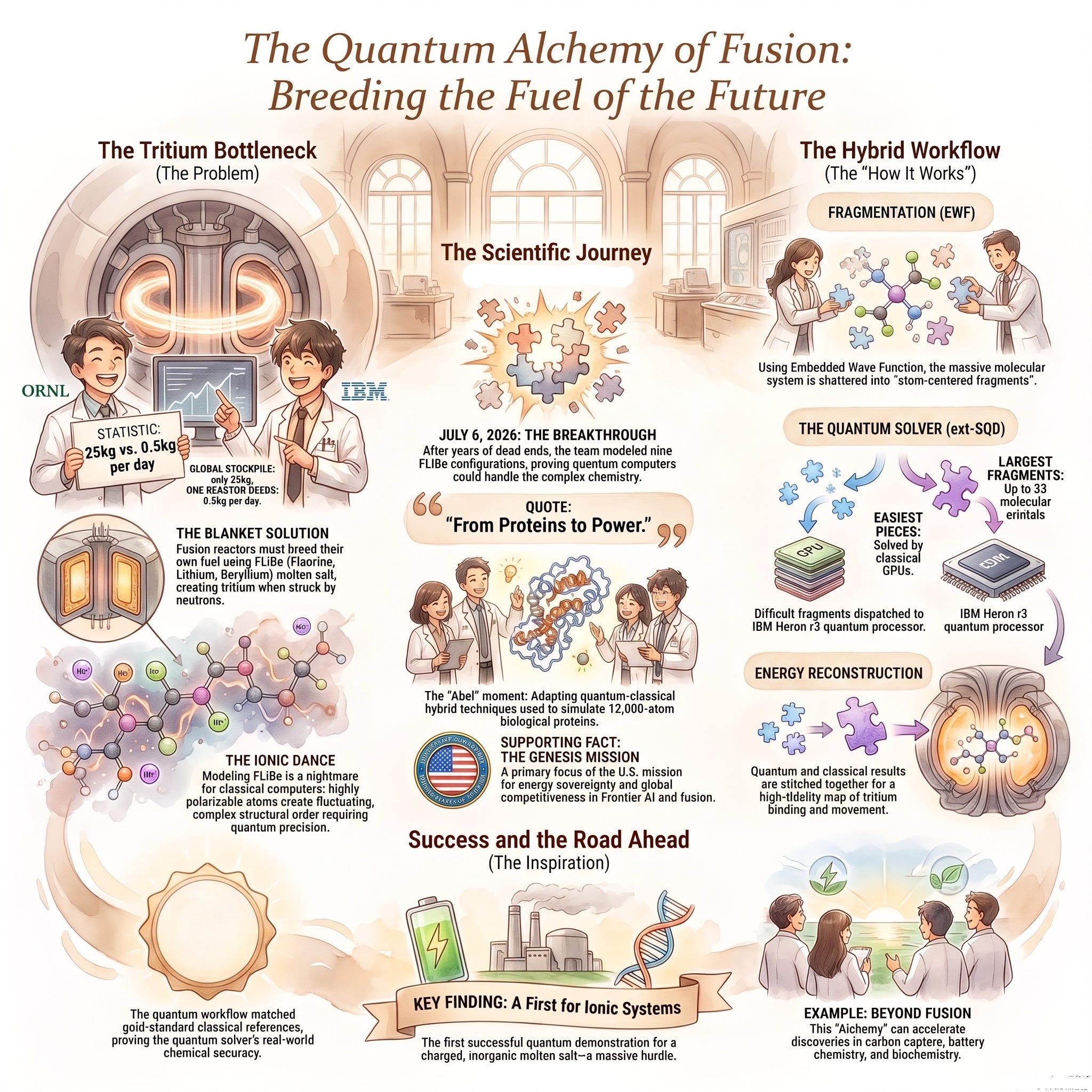
Image (3000 x 3000 pixels)

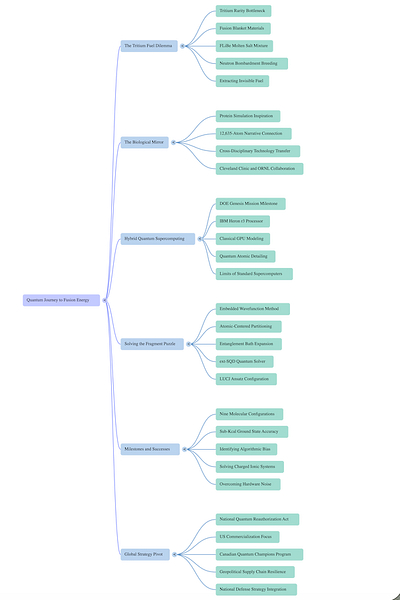
Mind Map
Comic

Street Art

Infographics
Trailer
https://youtube.com/shorts/m4EGsAivHZ8