
🐟 Defying Rules with Vujá Dé
Old rules fade like mist—
Fresh eyes see the path forward.
Courage blooms from doubt.
With every article and podcast episode, we provide comprehensive study materials: References, Executive Summary, Briefing Document, Quiz, Essay Questions, Glossary, Timeline, Cast, FAQ, Table of Contents, Index, Polls, 3k Image, Fact Check, Comic and
Street Art at the very bottom of the page.
Soundbite
Essay
The Courage to Forget What You Know: Why Real Change Requires Unlearning
We live in a world obsessed with learning. Conferences promise to teach us the “latest strategies.” Books offer “frameworks for success.” Podcasts deliver “insights from industry leaders.” And yet, the most transformative figures in history—the ones who actually changed their fields—didn’t succeed by learning more. They succeeded by forgetting.
Terry O’Reilly’s Against the Grain introduces us to a concept borrowed from writer Bill Taylor: vujá dé. It’s the opposite of déjà vu. Instead of the eerie feeling that you’ve seen something before, vujá dé is the practice of looking at something utterly familiar—a problem you’ve encountered hundreds of times—as if you’ve never seen it before. You actively scrub your brain clean of assumptions, biases, and the well-worn paths that everyone else follows.
This isn’t just clever wordplay. It’s the pattern that connects every giant who changed the world.
The Tyranny of “Best Practices”
Albert Lasker walked into the advertising world in 1898 when agencies were glorified middlemen. They brokered space in newspapers and magazines. They placed ads written by clients. The industry had a standard operating procedure, a comfortable ecosystem, a way things were done.
Then a stranger in a saloon sent up a note: “I can tell you what advertising is. I know you don’t know.”
The audacity. The presumption. Lasker’s partner scoffed. But Lasker, young and curious, said yes. And in walked Johnny Kennedy with a phrase that would unlock modern commerce: “Advertising is salesmanship in print.”
That’s it. Four words that changed everything because they reframed the entire game. Advertising wasn’t about visibility or publicity—vague, unmeasurable concepts. It was about results. It was about persuasion with a direct line to the bottom line.
Lasker paid Kennedy the equivalent of $3 million in today’s money. The industry was apoplectic. J. Walter Thompson himself scolded Lasker, insisting no copywriter was worth more than $3,000 a year. But Lasker understood something his peers didn’t: he wasn’t paying for words. He was paying for the blueprint of an entirely new way of thinking.
The campaigns that followed—Palmolive Soap pivoting from hygiene to beauty, Sunkist creating the concept of daily orange juice, Kotex installing dispensers so women could buy products without speaking to a clerk—weren’t just clever marketing. They were empathetic reimaginings of what products could mean to people.
And here’s the twist: forty years later, Lasker’s model became the establishment. The thing that needed to be defied.
When the Revolutionary Becomes the Tyrant
Bill Bernbach saw it coming. In 1947, he wrote a warning letter to his bosses at Gray Advertising. The industry, he said, was falling into “the trap of bigness.” It was worshiping technique over art, following history instead of making it. Originality was being sacrificed for safety.
His bosses didn’t listen. So he left and co-founded Doyle Dane Bernbach with a radical philosophy: “I’ve got a great gimmick. Let’s tell the truth.”
When DDB took on Volkswagen—a German car, fifteen years after World War II, from a Jewish-led agency—they could have played it safe. They could have hidden the car’s flaws: it was small, slow, ugly, cheap. Instead, they embraced them. “Think Small.” “Lemon.” They used humor and transparency and self-deprecation.
The vulnerability built trust in a way aggressive boasting never could. The campaign is still the most studied in advertising history.
Then came Avis: “We’re only #2, but we try harder.” Half the focus group hated it. The research screamed, “Don’t do it.” Conventional wisdom said being second place was nothing to advertise. But Bernbach understood that people are naturally skeptical of market leaders. Being number two gave them instant credibility. It was a sympathetic story. And it worked immediately.
What Lasker built, Bernbach broke. And both were necessary. Both were acts of defiance against the prevailing wisdom of their time.
The Forest Isn’t a Battlefield
Sometimes the thing we need to unlearn isn’t a business practice. It’s a fundamental way of seeing the world.
For decades, forest management operated under the “free-to-grow” policy. The forest was a battlefield. Trees competed ruthlessly for resources. “Weed” species like birch had to be eradicated with herbicides so commercially valuable trees like fir could thrive. It was survival of the fittest, red in root and branch.
Suzanne Simard’s gut told her this was wrong. The forest felt like a community, not a war zone. But gut feelings don’t overturn entrenched scientific dogma. She needed proof.
So she designed an ingenious experiment using radioactive carbon isotopes. She’d seal birch and fir seedlings in plastic bags, pump radioactive gas into the birch, and track where the carbon went. If competition was the only game, the carbon would stay in the birch. If cooperation existed, it would travel.
The results were astonishing. The radioactive carbon showed up in the shaded fir seedlings. The birch—the “demon weed” the logging industry was paying to destroy—was generously donating its resources to the struggling fir through an underground fungal network. The “wood wide web.”
Trees weren’t just competing. They were cooperating. The forest wasn’t a battlefield. It was a community taking care of its own.
Simard was labeled a troublemaker. Policymakers walked out of her presentations. She received ethical misconduct warnings for speaking out. But her science was undeniable. Eventually, British Columbia reduced herbicide spraying by 50%.
She had to forget everything the industry “knew” to see what was actually true.
The Price of Being Right Too Early
Here’s what unites all these stories: fury.
When you defy cherished beliefs, you don’t get polite disagreement. You get rage. The status quo doesn’t just defend itself intellectually—it attacks personally.
Gustave Eiffel’s tower was called a “gigantic black factory chimney” and a “useless and monstrous” structure. Citizens sued because they feared it would fall on their houses. The Parisian artistic elite was incensed.
Dick Fosbury was mocked as “the world’s laziest high jumper” who looked “like a fish flopping into a boat” when he invented the backwards high jump technique. Today, every elite high jumper in the world uses the Fosbury Flop.
Tom Laughlin had to risk his house—literally sign it away as collateral—to prove that his marketing methods for Billy Jack would work. Warner Bros. had tried to kill his film by scrawling its title on butcher paper outside B-circuit theaters. His defiance created the modern blockbuster release model.
The fury isn’t incidental. It’s evidence. When you threaten the assumptions that protect people’s investments, their identities, their sense of competence, they don’t thank you for the insight. They try to destroy you.
What Are You Refusing to Forget?
Here’s the uncomfortable question: What widely accepted belief in your field have you internalized so completely that you can’t even see it as a belief anymore? What have you decided is “just how things work”?
Because that’s probably the thing worth questioning.
The defiant giants in O’Reilly’s book weren’t smarter than their peers. They weren’t better educated or more talented. What they had was the courage to treat familiar problems as if they’d never seen them before. To ignore the artificial boundaries that fenced in everyone else’s imagination.
Richard Williams wrote a 78-page plan to bring two Black girls from gang-ridden Compton to the top of the whitest, most elitist sport in the world. People thought he was delusional. He fought gang members for a year just to control public tennis courts. He lost teeth. He got broken ribs. And he turned down an $87 million sponsorship deal because it didn’t fit his plan.
Today, Venus and Serena Williams are among the greatest athletes in history.
Antanas Mockus became mayor of Bogotá—one of the world’s most dangerous cities—and hired mimes to replace corrupt traffic police. The press called it a frivolous stunt. Pedestrian deaths dropped by more than half. The homicide rate fell 70% over the next decade.
These aren’t stories about genius. They’re stories about willingness. The willingness to look foolish. To risk everything. To stand alone while the crowd screams that you’re wrong.
The Loneliness of Unlearning
There’s something we don’t talk about enough: how isolating it is to see things differently. When everyone around you agrees that X is true, and you suspect X might be built on a foundation of unexamined assumptions, you have two choices. You can stay quiet and fit in. Or you can speak up and become the troublemaker.
Most of us choose silence. It’s the rational choice. The safe choice. The choice that protects your career, your reputation, your sense of belonging.
But progress doesn’t happen through rational caution. It happens when someone decides that being right is more important than being comfortable.
Kelly Johnson at Lockheed Skunk Works delivered a turbojet fighter in 143 days—37 days ahead of an “impossible” 180-day deadline—by creating a micro-company free from corporate bureaucracy. He proved that small autonomous teams could shatter the illusion that red tape was necessary.
Bill Bernbach paired writers with art directors—a structure so obvious now that it’s hard to believe it was revolutionary. But back then, they worked in separate departments. The art director just laid out whatever the writer handed them. Bernbach insisted ideas had to be born collaboratively. That synergy is where the magic came from.
These organizational innovations feel small. They weren’t dramatic or glamorous. But they changed everything because they questioned assumptions everyone else treated as immutable laws of nature.
The Question That Changes Everything
O’Reilly’s book asks us to sit with an uncomfortable question: What widely accepted sacred belief in your own field or life, if challenged, could revolutionize the path forward?
Are you willing to embrace vujá dé? To look at the problem everyone agrees is intractable and ask, “What if we’re all wrong about this?”
Are you willing to risk the fury? Because it will come. The moment you threaten the status quo, you become its enemy.
But here’s the thing about defiant giants: they don’t do it for glory. They do it because they’ve seen a better way, and once you’ve seen it, you can’t unsee it. The cost of staying silent becomes higher than the cost of speaking up.
Taylor Swift re-recorded her entire back catalog to regain control of her master recordings after they were sold without her consent. She didn’t just fight legally—she brought her fans along, educating them about why ownership matters. Major networks publicly agreed to only play “Taylor’s Version.” It was a masterclass in leveraging loyalty over institutional power.
The “Taylor Effect” didn’t just break records. It shattered them. Her Eras Tour generated $2 billion in ticket sales and boosted the U.S. economy by $5.7 billion. Time named her Person of the Year in 2023—the first entertainer ever to receive that recognition.
She proved that in this new era, control and loyalty are the ultimate forms of leverage. She forgot what every artist had been told about how the music industry worked. And she built something new.
The Invitation
This isn’t a call to be contrarian for its own sake. Defiance without purpose is just noise. But defiance rooted in a genuine vision of something better? That changes the world.
The pattern is clear: look at what everyone accepts as inevitable. Question it. Imagine alternatives. Build proof. Expect fury. Persist anyway.
Because the people who change the world aren’t the ones who know the most. They’re the ones brave enough to forget what everyone else “knows.”
The question isn’t whether you have revolutionary ideas. The question is whether you have the courage to unlearn enough to find them.


Link References
Against the Grain: Defiant Giants Who Changed the World by Terry O’Reilly
Under the Influence (radio series)
Episode Links
Available for broadcast on PRX
Other Links to Heliox Podcast
YouTube
Substack
Podcast Providers
Spotify
Apple Podcasts
Patreon
FaceBook Group
STUDY MATERIALS
Briefing
Executive Summary
This document synthesizes the core themes and evidence presented in Terry O’Reilly’s Against the Grain: Defiant Giants Who Changed the World. The central thesis of the work is that monumental, world-changing advancements are frequently driven not by established institutions, but by defiant individuals and groups who challenge conventional wisdom, break foundational rules, and persevere through immense resistance. The book profiles a diverse collection of innovators across entertainment, business, politics, science, and sports, demonstrating a universal pattern of disruption.
Key unifying themes emerge from these case studies:
• Perseverance Against Institutional Resistance: Nearly every subject faced decades of skepticism, ridicule, funding rejection, and professional ostracism from the very fields they sought to advance. From Katalin Karikó’s lonely work on mRNA to Suzanne Simard’s fight against forestry dogma, success was contingent on enduring isolation and hostility.
• The Power of Counterintuitive Thinking: The subjects achieved breakthroughs by rejecting established norms. Tom Laughlin revolutionized film marketing by suing his own distributor, Antanas Mockus fought crime with mimes instead of police, and Hungary’s Golden Squad dismantled soccer’s rigid tactics with fluid, position-less play.
• Willpower and Unshakeable Conviction: The protagonists are defined by their sheer grit and an unwavering belief in their vision. Gustave Eiffel staked his personal fortune on his tower against the scorn of Paris’s elite, and Richard Williams executed a 78-page plan to raise two tennis superstars from the gang-ridden courts of Compton, armed only with a dream and relentless determination.
Collectively, these stories argue that true innovation is an act of rebellion. It requires not just a brilliant idea, but the extraordinary courage to defy the status quo and the resilience to withstand the backlash that inevitably follows. The marks left by those who go “against the grain” ultimately become the new grain for future generations.
--------------------------------------------------------------------------------
Part 1: Revolutionizing Entertainment
Tom Laughlin & Billy Jack: Forging a New Hollywood Playbook
Filmmaker Tom Laughlin, creator of the Billy Jack series, fundamentally altered film distribution and marketing by waging a direct war against the established Hollywood studio system.
• Conflict with Warner Bros.: After Warner Bros. acquired his film Billy Jack with a verbal promise of a major marketing push, the studio instead “dumped” the movie onto the B-circuit with no promotional support. Laughlin, furious at the betrayal, did the unthinkable: he sued his own distributor.
• Pioneering Marketing Tactics: As part of a settlement, Laughlin gained control over the film’s marketing in three test cities. To ensure success, he initiated several industry firsts:
◦ Focus Groups: He was the first in Hollywood to use focus groups, showing audiences the film and then the advertising to gauge if the marketing accurately reflected the movie’s message. Based on feedback, he completely re-edited the commercials.
◦ Demographic Targeting: Laughlin identified 12 distinct demographic segments that would respond to the film and created tailored ad campaigns for each. This included the first “split-run” in movie marketing, placing different ads in the sports and women’s sections of newspapers.
◦ Saturation TV Advertising: Laughlin believed in the power of television to drive ticket sales, a strategy studios had not yet embraced. He launched a saturation campaign featuring moviegoer testimonials, a novel approach at the time.
◦ Unorthodox Promotion: He used bus benches and billboards in cities outside of Times Square, another industry first, making movie billboards a hot commodity.
• Revolutionizing Film Distribution: For the sequel, The Trial of Billy Jack, Laughlin defied the traditional slow-release strategy. To fund a national TV ad campaign, he demanded the film open in 1,000 theaters simultaneously, an unprecedented move that top executives predicted would be a disaster. The film became the most successful independent film of all time, and his methods became the standard for every major Hollywood blockbuster that followed.
Taylor Swift: The Maverick Marketer and Industry Disruptor
Taylor Swift is presented as a singular force who leverages a deep, authentic connection with her fanbase to challenge and reshape the music industry’s power structures.
• Regaining Control: After her original master recordings were sold without her consent, Swift announced she would re-record all six of her original albums. This bold strategy, branding the new releases as “Taylor’s Version,” was embraced by her fans (”Swifties”), who understood it as an act of reclaiming her artistic legacy. The re-recorded albums consistently outperformed the originals.
• Deep Fan Engagement: Swift cultivates an unparalleled relationship with her fans through several unique methods:
◦ “Tay-lurking”: She quietly monitors her fans’ social media posts to understand them and identify superfans.
◦ Secret Sessions: She has invited hundreds of fans into her homes for secret listening parties for new albums, specifically choosing those who previously could not afford or obtain tickets to her shows.
◦ “Easter Eggs”: She embeds clues about upcoming music in her social media posts, music videos, and even her choice of nail polish color, turning each new release into a major interactive event for her fans.
• Economic Phenomenon (The “Taylor Effect”): Swift’s economic impact is immense. Her “Eras Tour” was projected to earn over $2 billion, doubling the gross of any other tour in history. The tour was estimated to have boosted the U.S. economy by $5.7 billion, with the average concertgoer spending $1,300.
• Challenging the Status Quo: Swift has successfully challenged industry giants, winning concessions from Apple and Spotify for better artist compensation and forcing Ticketmaster to revise its processes. She self-published a bestselling book and, in an ironic twist, used the revenue from the Eras Tour—a tour prompted by the loss of her masters—to finally purchase her original six albums in May 2025.
Norman Lear & All in the Family: Using Comedy as a Social Disinfectant
Television producer Norman Lear defied network censorship and broadcasting conventions to create sitcoms that tackled contentious social issues, forever changing the medium.
• A New Kind of Sitcom: Inspired by the British series Till Death Do Us Part, Lear created All in the Family to put a “humorous spotlight on our frailties, prejudices and concerns.” He aimed to use humor and sunlight as a “disinfectant” for bigotry.
• Battles with Censors: Lear was in a constant state of war with the CBS Program Practices department (the censors) over the show’s content. Key battles included:
◦ Homosexuality: Censors demanded the word “fag” be replaced with “less offensive terms like ‘pansy,’ ‘sissy,’ or even ‘fairy.’” Lear fought to keep the language authentic to the bigoted main character, Archie Bunker.
◦ Impotence: When a script tackled the temporary impotence of a main character, CBS executives, including president Bob Wood, flew from New York to Los Angeles to try to kill the episode. Lear refused to back down.
◦ A Single Line: Twenty minutes before the pilot was set to air, Lear was in a standoff with the network over a line of dialogue (”...it won’t fly in Des Moines, Iowa.”). Lear threatened to walk away from the entire series rather than concede, knowing that losing the first battle meant he would never win another. CBS blinked, and the episode aired as written.
• Changing Television Forever: All in the Family became a cultural phenomenon, winning three Emmys in its first season and ranking in the top ten for eleven straight years. It proved that audiences were ready for mature, issue-oriented comedy. The show’s success launched a universe of progressive spin-offs, including Maude (which tackled abortion), Good Times (the first sitcom about a struggling Black family in the projects), and The Jeffersons. Rob Reiner noted that Lear, having flown 52 bombing missions over Nazi Germany, viewed fighting with network executives as “small potatoes.”
--------------------------------------------------------------------------------
Part 2: Disrupting Business & Industry
Albert D. Lasker: The Father of Modern Advertising
Albert Lasker transformed the advertising industry from a simple media brokerage into a creative field of persuasion by championing a single, powerful idea.
• The Epiphany: “Salesmanship in Print”: In the early 1900s, advertising agencies primarily sold space in publications. Lasker was obsessed with understanding what made advertising effective but found no clear answers. One day, a man named John E. Kennedy sent a note up from a saloon stating, “I can tell you what advertising is.” Intrigued, Lasker met him. Kennedy’s definition was three simple words: “Salesmanship in print.”
• A New Philosophy: This concept was an epiphany for Lasker. It meant that advertising had to do more than inform; it had to persuade, give consumers reasons to buy, and have the charm and personality of a great salesperson.
• Building Iconic Brands: Armed with this new philosophy and hiring top copywriters like Kennedy and Claude Hopkins, Lasker’s agency, Lord & Thomas, launched campaigns that created household names:
◦ Palmolive Soap: Positioned soap not as a cleanser but as a “beauty appeal” product, a radical idea at the time. It became the bestselling soap in the world.
◦ Sunkist Oranges: Faced with an orange surplus, he created the concept of “orange juice,” turning a fruit that was rarely consumed into a daily staple.
◦ Kotex & Kleenex: He fought magazine publishers to run ads for Kotex “sanitary napkins” and solved in-store embarrassment by having them sold in plain wrappers next to a change box. For Kleenex, he pivoted the marketing from makeup removal to “Disposable Handkerchiefs,” coining the slogan, “Don’t put a cold in your pocket.”
Bill Bernbach: The Creative Revolution
Bill Bernbach of Doyle Dane Bernbach (DDB) led the “creative revolution” of the 1960s by rejecting the formulaic, “scientific” approach to advertising in favor of wit, honesty, and artistry. His core belief was, “Advertising is fundamentally persuasion and persuasion happens to be not a science, but an art.”
• A New Agency Model: Bernbach broke down the walls between writers and art directors, pairing them into creative teams. This radical idea, which ensured words and visuals were conceived together, is now the universal standard in the industry.
• The Power of Honesty: Bernbach’s signature was a disarming, self-deprecating honesty that stood in stark contrast to the hyperbolic claims common in advertising.
◦ Volkswagen: Tasked with selling a “small, cheap, ugly, slow, imported Nazi car” to Americans, DDB created ads that embraced the car’s perceived flaws. Headlines like “Think small” and “Lemon” celebrated the VW’s honesty, simplicity, and reliability.
◦ Avis: For the rental car company that was losing money and trailing Hertz, Bernbach created the legendary campaign: “We’re only #2, but we try harder.” No company had ever boasted about being second best. The campaign was a massive success, increasing Avis’s market share dramatically.
• Defying Convention: Bernbach consistently broke the established rules of Madison Avenue. He believed, “Rules are prisons.” He rarely used slogans, insisted on creative politeness rather than intrusive hard-sells, and argued that a good agency must be willing to stand up to its clients.
Jorge Heymann: A Bridge to Success with “Vujà Dé”
Advertising creative Jorge Heymann demonstrated radical, counterintuitive problem-solving by proposing a physical structure instead of a marketing campaign for a client.
• The Problem: The Madero Este real estate development in Buenos Aires was in a remote, inconvenient location. The client expected a $4 million multi-media ad campaign to drive traffic.
• The “Vujà Dé” Solution: Heymann’s agency recognized that the core problem was access, not awareness. Applying “vujà dé” (looking at a familiar situation as if for the first time), they made a revolutionary proposal: instead of an ad campaign, use the budget to build a pedestrian bridge to connect the complex to the city.
• A Landmark is Born: They pushed the idea further, recommending a world-class structure by a renowned architect, Santiago Calatrava. Though it cost $6 million (50% more than the ad budget), the resulting bridge, El Puente de la Mujer (”The Woman’s Bridge”), became a landmark attraction in its own right, generating more publicity than any ad campaign could have and solving the fundamental traffic problem.
Gustave Eiffel: The Iron Will
Gustave Eiffel’s construction of his iconic tower is a testament to singular vision and perseverance in the face of universal condemnation from the artistic, political, and public spheres.
• Immense Opposition: When Eiffel’s design for a 1,000-foot iron tower was chosen for the 1889 Paris Exposition, it was met with immediate and fierce hostility.
◦ A published protest signed by prominent artists and writers called the tower a “useless and monstrous,” “gigantic black factory chimney” that would spread “like an ink stain, the odious shadow of this odious column of bolted metal.”
◦ Citizens filed lawsuits, fearing it would collapse or cast permanent shadows on their homes. Newspapers ran fake headlines like “Eiffel Suicide!” and “Gustave Eiffel has gone mad.”
• Personal and Financial Risk: The government contributed only 1.5 million francs to the 6.5 million franc project. Eiffel took on full personal financial responsibility for the remainder, a colossal risk. In return, he shrewdly negotiated to receive all commercial income from the tower for 20 years, after which it was scheduled to be torn down.
• Precision Engineering: Eiffel’s patented construction process was his key to success. Every one of the 18,000 iron components was tooled at his foundry to an error margin of less than one-tenth of a millimeter. Parts arrived on-site ready to be fitted perfectly, requiring no on-site drilling or adjustments.
• Triumph and Legacy: The tower was completed on time and became the star of the Exposition. Eiffel recouped all his costs in the first year alone. The city of Paris later decided not to tear it down, and it remains one of the most recognized and beloved monuments in the world.
Clarence “Kelly” Johnson & Skunk Works
Aeronautical engineer Kelly Johnson revolutionized aircraft development under extreme pressure by creating a small, autonomous, and secretive team that bypassed corporate and military bureaucracy.
• The Impossible Task: In 1943, with Nazi Germany developing a 600-mph jet fighter, the U.S. Air Force gave Johnson an impossible deadline: design and build America’s first operational jet fighter, the Shooting Star, in just 180 days. A typical timeline was over two years.
• The Birth of Skunk Works: Lockheed had no spare engineers or space. Johnson was forced to assemble his own team and build a makeshift facility under a circus tent next to a foul-smelling plastics factory. This secret project became known as “Skunk Works.”
• A New Way of Working: Johnson operated under a simple motto: “Dammit . . . Do it!” He consolidated all authority, tolerating no bureaucracy, red tape, or delays. The team worked ten-hour days, six days a week, under a giant countdown calendar. His management style, codified in “The 14 Practices and Rules,” became the blueprint for rapid, innovative projects.
• Legendary Success: Despite the immense pressure and a late engine delivery from England, Johnson’s team delivered the Shooting Star in 143 days—37 days ahead of schedule. A Lockheed executive later summed up the achievement as “an existential threat and a magical man.”
--------------------------------------------------------------------------------
Part 3: Unconventional Politics & Law Enforcement
Justin Trudeau: The Power of Positive Politics
Justin Trudeau’s 2015 Canadian federal election campaign defied conventional political wisdom by refusing to engage in negative attacks and instead directly confronting his opponent’s main line of attack with a positive vision.
• The Underdog: In early 2015, Trudeau’s Liberal Party was in a distant third place. The incumbent Conservative Party was running a heavy rotation of attack ads with the central message: “He’s just not ready.”
• Breaking the Golden Rule: The unwritten rule of politics is to never acknowledge an opponent’s attack, as it gives their message more oxygen. Trudeau’s team, led by the Bensimon Byrne agency, chose to break this rule. Their lead-off commercial featured Trudeau stating, “Stephen Harper says I’m not ready,” before turning the phrase into a positive platform for his own policies.
• The Escalator Ad: A pivotal commercial showed Trudeau walking up a downward-moving escalator, a visual metaphor for the struggling middle class. The ad was simple, bold, and optimistic, and it signaled the turning point in the election, pulling all three parties into a virtual tie.
• Victory Through Positivity: While his opponents focused on divisive cultural issues, Trudeau presented a message of inclusivity, transparency, and optimism. This positive strategy allowed him to wrestle the “change” platform away from the leading opposition party and win a stunning majority government.
Antanas Mockus: The Mime Mayor of Bogotá
As mayor of Bogotá, one of the world’s most dangerous cities in the 1990s, professor-turned-politician Antanas Mockus used bizarre, artful, and creative interventions—a strategy he called “cultural acupuncture”—to transform civic behavior where traditional law enforcement had failed.
• Unconventional Tactics:
◦ Mimes for Traffic Control: Instead of police, Mockus hired 420 mimes to patrol the streets. They would mock jaywalkers and applaud citizens who obeyed traffic laws. Pedestrian deaths dropped by more than 50%. The mimes succeeded not by training drivers, but by training pedestrians to understand and assert their rights.
◦ Super Citizen: He donned a yellow spandex superhero costume with a “C” for “Citizen” on the chest to promote civic culture and fight corruption.
◦ Voluntary Taxes: When the City Council rejected a tax increase, Mockus invited the public to pay “voluntary impositions.” Over 63,000 citizens voluntarily paid 10% more in taxes.
◦ Water Conservation: During a severe water shortage, he appeared in a TV commercial showering and asking citizens to turn off the water while soaping up. Water usage dropped by 40%.
• A City Transformed: By treating the city as a “classroom of six million,” Mockus’s playful and humorous methods successfully bridged the gap between law and culture, revitalizing public trust and dramatically reducing violence and corruption.
Kate Warne: The First Female Detective
In 1856, Kate Warne became America’s first female detective by convincing Allan Pinkerton that a woman could “worm out secrets in many places which would be impossible for a male detective.”
• A Unique Advantage: Warne argued that women are naturally observant and that men become boastful around them, making it easy to extract information. Pinkerton hired her, making a revolutionary decision for the time.
• The Baltimore Plot: Warne’s most critical case was foiling the 1861 “Baltimore Plot” to assassinate President-elect Abraham Lincoln.
◦ Undercover Work: Going undercover with a Southern accent as “Mrs. Cherry,” Warne infiltrated high-society secessionist gatherings and learned the details of the plot: Lincoln was to be murdered in Baltimore while changing trains on his way to his inauguration.
◦ The Rescue: Warne orchestrated Lincoln’s secret escape. She disguised him in an overcoat and felt hat, posing as the caregiver of her “invalid brother.” She bribed a train master for berths, and her team cut telegraph wires to prevent the conspirators from communicating.
• Legacy: Warne successfully delivered Lincoln to Washington, D.C. The Pinkerton Agency’s logo—a large, unblinking eye with the motto “We Never Sleep”—is said to have been inspired by her vigilance and gave rise to the term “private eye.”
--------------------------------------------------------------------------------
Part 4: Scientific & Medical Heresy
Judah Folkman: The Angiogenesis Theory
Dr. Judah Folkman was a surgical prodigy who spent over thirty years battling the medical establishment over his revolutionary theory of angiogenesis—the idea that cancer tumors could be starved by cutting off the growth of the blood vessels that feed them.
• Visionary’s Dilemma: Folkman’s instincts ran far ahead of the data. His theory was met with decades of intense criticism, ridicule, and rejection from his peers at Harvard and beyond.
• A Career of Rejection: His grant proposals were constantly turned down. Reviewers called his work a “hopeless search” and accused him of trying to “invent a way to walk on water.” He was ostracized for being a surgeon dabbling in biochemistry, an area outside his perceived expertise.
• The Breakthrough: In 1971, after years of failure, his lab finally achieved the “impossible” feat of growing endothelial cells (the cells that line blood vessels) in a culture. This allowed him to prove he could turn blood vessel growth on and off, validating his theory. Even then, the scientific community reacted with laughter and disbelief.
• Vindication: Folkman persisted, eventually securing funding from Monsanto. His work pioneered an entirely new field of medicine, leading to the development of over a dozen anti-angiogenic drugs now used to treat cancer and other diseases worldwide.
Katalin Karikó: The Persistence of mRNA
Scientist Katalin Karikó’s four-decade-long, unwavering belief in the therapeutic potential of messenger RNA (mRNA) is a story of profound resilience against institutional rejection, culminating in one of the most significant medical breakthroughs of the 21st century.
• A Career of Setbacks: At the University of Pennsylvania, Karikó’s research into mRNA was systematically dismissed.
◦ She was repeatedly denied grants and viewed as a liability by her superiors, who measured success in “dollars per net square footage.”
◦ In 1995, after six years of rejection, she was demoted from her faculty track position—a deep humiliation for a dedicated scientist. She accepted the demotion to continue her work.
◦ Years later, the department chair told her she was “not of faculty quality” and rejected her request for reinstatement.
• The Key Discovery: Working with immunologist Drew Weissman, Karikó solved the critical problem holding back mRNA therapeutics: the body’s inflammatory response. They discovered that modifying one of mRNA’s building blocks, uridine, made the mRNA “invisible” to the immune system.
• Delayed Recognition: They published their paradigm-shifting findings in 2005. The response was silence. The phone did not ring. For the next two years, Karikó received only two invitations to speak. In 2013, her lab was taken away, and her belongings were put in the hallway to make room for new faculty with grants.
• Global Impact: Karikó left academia for BioNTech. Years later, her foundational discovery became the basis for the Pfizer-BioNTech and Moderna COVID-19 vaccines, saving millions of lives and finally vindicating her decades of thankless work.
Suzanne Simard: The Wood-Wide Web
Forest ecologist Suzanne Simard challenged a century of forestry dogma by proving that forests are not merely collections of competing individuals, but vast, cooperative communities connected by a subterranean fungal network.
• Challenging Competition Theory: The logging industry and academia operated on the “free to grow” theory that trees compete for resources, necessitating the clear-cutting of “weed” trees like birch and alder to promote the growth of commercially valuable fir and pine.
• A Controversial Discovery: Simard’s gut instincts and experiments proved this theory wrong. She discovered that different tree species were engaged in a two-way exchange of resources like carbon, water, and nutrients through a complex underground web of mycorrhizal fungi.
• The Mother Tree Concept: Her research revealed that the largest, oldest trees—which she controversially termed “Mother Trees”—act as central hubs, nurturing seedlings and the surrounding forest by sharing resources through the network.
• Backlash and Misogyny: Simard’s findings were met with intense resistance.
◦ At presentations, policymakers would walk out, and colleagues would dismiss her work as taking place at a “special research site” not applicable to the “real world.” A friend told her the crowd didn’t like hearing that kind of research “from a woman.”
◦ She was criticized for “anthropomorphizing” trees, a taboo in science, even though it was an effective way to communicate her complex findings to the public.
• Vindication: Despite the backlash, Simard’s research slowly began to change policy, leading to a 50% reduction in herbicide spraying in British Columbia. Her work has fundamentally changed our understanding of forests as intelligent, interconnected systems.
--------------------------------------------------------------------------------
Part 5: Reinventing Sports
Roger Neilson: “Rule Book Roger”
Legendary NHL coach Roger Neilson was a relentless innovator who changed hockey by pioneering new coaching methods and masterfully exploiting loopholes in the official rule book.
• Pioneering Technology: Known as “Captain Video,” Neilson was the first coach to use videotape as a teaching tool to break down games for his players, a practice that is now standard across all professional sports.
• Exploiting the Rules: Neilson’s deep knowledge of the rules allowed for creative and often outrageous tactics to gain an advantage:
◦ On penalty shots, he would pull his goalie and send a defenseman out to charge the shooter at the blue line. The league later changed the rule to mandate a goalie be on the ice.
◦ To protect a lead, he would leave his goalie’s stick on the ice in front of the empty net, knowing an opponent’s shot might deflect off it. The league banned this tactic.
◦ When short-handed and protecting a lead, he would deliberately put too many men on the ice repeatedly in the final seconds, knowing the penalty was less severe than giving up a goal. The league introduced a penalty shot for this violation.
• Towel Power: In a 1982 playoff game, protesting what he felt was biased officiating, Neilson had his players put white towels on the ends of their sticks and raise them in a gesture of mock surrender. This act of defiance became a legendary moment in Canucks history, sparking the “Towel Power” tradition that continues today.
Dick Fosbury: The Flop
At a time when all high jumpers used variations of the forward-facing “straddle” or “Western roll,” high school athlete Dick Fosbury accidentally invented a completely new, backwards-first technique that revolutionized the sport.
• An Unorthodox Discovery: Struggling with the conventional straddle technique, Fosbury instinctively reverted to an older, simpler “scissors” jump. To get more height, he began lifting his hips, which caused his shoulders to go back, leading him over the bar backwards. Over time, he refined this into a curved approach and full-body arc.
• From Joke to Genius: His style was initially met with ridicule. A newspaper photo caption called him the “World’s Laziest High Jumper,” and another article said he “looked like nothing more than a fish flopping into a boat.” He embraced the mockery, christening his technique the “Fosbury Flop.”
• Olympic Gold: Coaches tried to force him to learn the “correct” straddle technique, but he always reverted to the flop in competition. At the 1968 Olympics in Mexico City, he was seen as a novelty. The crowd laughed at his first jumps. But as competitors were eliminated, the laughing stopped. Fosbury won the gold medal, set a new Olympic record, and turned his back on conventional thinking forever. Today, every high jumper in the world uses the Fosbury Flop.
Hungary’s Golden Squad: Tactical Revolutionaries
In the 1950s, the Hungarian national soccer team, known as the “Golden Squad,” shattered the rigid, hierarchical tactics of world soccer, particularly those of the dominant English team, with a fluid, innovative style that has been compared to “total football.”
• The “Match of the Century”: On November 25, 1953, Hungary faced an English team that had never lost a home game to a non-British opponent in 81 years. The Hungarians, considered 500-to-1 underdogs, stunned the 120,000 fans at Wembley Stadium, winning 6-3 in a match that was far more dominant than the score indicated. England was outshot 35-5.
• Strategic Anarchy: English soccer was defined by rigid positions and a set playbook. The Hungarians dismantled this with a fluid system where players constantly switched positions, submerging their egos to play as one unit. It baffled their opponents. English player Syd Owen said, “It was like playing people from outer space.”
• A New Era: The humiliating defeat forced England to completely reinvent its game and acknowledge that it had fallen behind the rest of the world in tactics and strategy. The Golden Squad’s brilliance influenced soccer for decades.
Richard Williams: The 78-Page Plan
Richard Williams orchestrated one of the most audacious and successful stories in sports history by conceiving and executing a detailed plan to turn his two unborn daughters, Venus and Serena, into world tennis champions, despite having no knowledge of the game and facing the immense obstacles of poverty and systemic racism.
• The Dream: In 1978, after seeing a female tennis player win a $40,000 check for four days’ work, Williams declared, “I’m going to have two kids and put them into tennis.” He then wrote a 78-page plan detailing every aspect of their future training before they were even conceived.
• Forged in Compton: Williams chose to train his daughters on the public courts of Compton, California, which were ruled by violent gangs. He fought for two years, suffering beatings that left him with broken ribs, a broken nose, and knocked-out teeth, until the gangs finally ceded the courts to him. He wanted his daughters to be “mental tough” and believed that if they could succeed there, they could succeed anywhere. He would even hire kids to hurl racial slurs at them during practice to prepare them for the hostility they would face.
• The Williams Life Triangle: He coached them based on a philosophy he called “The Williams Life Triangle,” with Courage, Commitment, and Confidence at the corners, and Faith inside. He insisted on being their father first and coach second, prioritizing education and character above tennis.
• Defying the Establishment: He defied the elite tennis establishment at every turn, pulling his daughters from the junior circuit to protect them from burnout and competitive parents, and turning down lucrative early sponsorship deals to allow them to develop at his own pace. His plan, which many considered insane, produced two of the greatest and most dominant athletes of all time.
Quiz & Answer Key
Instructions: Answer the following questions in two to three sentences each, based on the provided source material.
1. What was John E. Kennedy’s three-word definition of advertising, and why was it an epiphany for Albert Lasker?
2. Describe two specific, unconventional marketing tactics Tom Laughlin pioneered for the movie Billy Jack that were new to Hollywood.
3. Why did Taylor Swift decide to re-record her first six albums, and how did she distinguish these new versions for her fans?
4. Explain the central conflict between Norman Lear and CBS censors over the pilot episode of All in the Family, and what was the ultimate outcome of their standoff?
5. What was the origin of the name “Skunk Works” for Clarence “Kelly” Johnson’s top-secret aircraft design team?
6. How did Antanas Mockus, mayor of Bogotá, use mimes to address the city’s traffic problems, and what was the effect?
7. What major personal and financial risk did Gustave Eiffel take to ensure his tower was built for the 1889 Exposition Universelle?
8. According to Bill Bernbach’s letter to Grey Advertising, what is the fundamental difference between advertising as a science and advertising as an art?
9. What pivotal event inspired Richard Williams to create a detailed, 78-page plan to raise two of his children to be tennis champions?
10. Describe the disguise and ruse Kate Warne created to help Abraham Lincoln secretly travel by train and evade the “Baltimore Plot.”
--------------------------------------------------------------------------------
Answer Key
1. John E. Kennedy’s definition of advertising was “Salesmanship in print.” This was an epiphany for Albert Lasker because it crystallized the idea that advertising must persuade and give people reasons to buy a product, not just inform them with straight facts. It transformed the advertising industry from simply placing ads to creating persuasive messages.
2. Tom Laughlin pioneered the use of focus groups to get audience feedback on advertising and re-edit commercials based on their responses. He also created the first “split-run” campaign, tailoring different print ads to specific demographics (e.g., a defiant Billy Jack for men in the sports pages, an ad with Jean on the women’s pages) to target audiences more effectively.
3. Taylor Swift announced she would re-record her first six original albums in order to regain control of her music after the master recordings were sold. To distinguish them, she adds the words “Taylor’s version” to the album titles. She also includes bonus songs “from the vault” to incentivize fans to embrace the new recordings.
4. The conflict centered on a line implying a married couple was going upstairs for sex on a Sunday morning, which CBS censors wanted to cut, claiming “It won’t fly in Des Moines, Iowa.” Lear refused to cut the line, believing he had to “begin as you mean to go on” to maintain creative control. Just before airtime, CBS relented and aired the pilot as taped, with the line intact.
5. The name originated from a popular comic strip called Li’l Abner, which featured a dilapidated factory called “Skonk Works” that brewed moonshine and emitted a foul smell. Johnson’s team was located next to a foul-smelling plastics factory, and an engineer jokingly answered the phone “Skonk Works!” The name stuck, though its spelling was later changed to “Skunk Works.”
6. Mockus hired 400 street mimes to regulate traffic by using performance instead of force. The mimes would mock jaywalkers and drivers who ignored traffic signals, while applauding citizens who obeyed the rules. The initiative successfully trained pedestrians to understand their rights and resulted in pedestrian deaths dropping by more than 50 percent.
7. With the government only contributing 1.5 million francs toward the 6.5 million franc cost, Eiffel committed himself—not his company—to bearing full financial responsibility for the tower’s construction. In exchange, he negotiated to receive all commercial income from the tower for twenty years, a deal the city expected would result in a crushing loss for him.
8. Bernbach argued that the “scientists” of advertising know all the technical rules but produce work with a “sameness” and “mediocrity of ideas.” He believed that advertising is fundamentally persuasion, which is an art, not a science. The “art” relies on a creative spark to produce inspiring, not just technically correct, work.
9. While watching television, Richard Williams saw a female tennis player from Romania receive a check for $40,000 for four days’ work, which was nearly his own annual salary of $52,000. Stunned by the earning potential, especially for a woman in sports, he immediately decided, “I’m going to have two kids and put them into tennis,” and began drafting his plan.
10. Kate Warne disguised Lincoln in a felt hat, droopy overcoat, and long shawl. She then posed as his “caregiver,” reserving sleeping berths for her “family” and their “invalid brother.” This allowed Lincoln, who played the part of a disabled man, to board the train and travel through stations without being recognized by conspirators.
Essay Questions
Instructions: The following questions are designed for longer, essay-format responses. Use detailed evidence from the source material to support your arguments. (Answers are not provided).
1. Using the examples of Tom Laughlin, Taylor Swift, and Norman Lear, analyze how “going against the grain” in the entertainment industry often involves challenging established distribution, marketing, and creative control models.
2. Compare and contrast the leadership philosophies and industry-changing innovations of advertising pioneers Albert Lasker and Bill Bernbach. How did each man revolutionize advertising by breaking the rules of his respective era?
3. Discuss the role of extreme willpower and personal risk in the face of public criticism and institutional opposition, as demonstrated by figures like Gustave Eiffel, Richard Williams, and Clarence “Kelly” Johnson.
4. Examine the challenges faced by scientific and medical innovators like Judah Folkman, Katalin Karikó, and Suzanne Simard. Analyze the sources of resistance they encountered from their professional peers and the persistence required to prove their controversial theories.
5. Explore how unconventional, creative, and symbolic tactics can be used to solve complex societal or strategic problems, using Antanas Mockus’s mayoral initiatives in Bogotá and Roger Neilson’s coaching tactics in the NHL as primary case studies.
Glossary of Key Terms
All in the Family
A groundbreaking sitcom created by Norman Lear that tackled controversial social subjects. Based on the British series Till Death Do Us Part, it featured a bigoted father, Archie Bunker, and his liberal son-in-law, Michael.
Angiogenesis
The process by which tumors recruit their own private blood supply in order to grow. Dr. Judah Folkman’s controversial theory was that stopping angiogenesis could render tumors dormant.
Baltimore Plot
A conspiracy by a secret society to assassinate Abraham Lincoln in Baltimore as he changed trains on his way to his inauguration. The plot was foiled by Allan Pinkerton and detective Kate Warne.
Fosbury Flop
An unorthodox high-jumping style created by Dick Fosbury, where he went over the bar backwards and head-first, landing on his shoulders. This technique revolutionized the sport and is used by every high jumper today.
Four-walling
A movie distribution strategy, pioneered by Tom Laughlin, that involves renting cinemas outright. This tactic gives the filmmaker control over the length of the movie’s run, which allows for a sustained advertising push.
Hungary’s Golden Squad
The Hungarian national soccer team of the early 1950s that revolutionized the sport. They played with a fluid, position-switching style that shattered England’s decades-long undefeated home record in 1953 and baffled the world’s best teams for six years.
Mother Trees
The oldest, largest trees in a forest, which function as hubs connected to hundreds of younger trees through a vast underground fungal network. They nurture the younger trees by passing resources like carbon, water, and nitrogen to them.
mRNA (messenger RNA)
A molecule that can be used to coax cells into making specific proteins on demand to fight disease. Katalin Karikó’s pioneering and long-ignored research into modifying mRNA was a critical breakthrough for developing new vaccines and medicines.
Salesmanship in print
A three-word phrase coined by copywriter John E. Kennedy that defined advertising as a form of persuasion, not just information. This concept, championed by Albert Lasker, revolutionized the ad industry by shifting its focus from media brokering to creative persuasion.
Skunk Works
The nickname for Clarence “Kelly” Johnson’s secretive, autonomous, and highly efficient aircraft development team at Lockheed. It became a model for small, innovative groups tasked with achieving extraordinary results on advanced projects under tight deadlines.
Swifties
The self-dubbed name for Taylor Swift’s devoted fans. They are known for their deep connection to her music and storytelling, following her through different “eras,” and engaging with her marketing, such as looking for “Easter eggs.”
Tay-lurking
A term for when Taylor Swift quietly watches her fans’ social media posts. She has used this method to identify and reward superfans, such as by inviting them to “Secret Sessions” at her homes.
Vujà dé
The opposite of déjà vu; it means looking at a familiar situation as if you have never seen it before. The term is used to describe the fresh, counterintuitive approach taken by Jorge Heymann’s ad agency, which proposed building a landmark bridge instead of running an ad campaign for a remote real estate development.
Timeline of Main Events
This document presents a chronological analysis of the pivotal moments, challenges, and breakthroughs experienced by a selection of influential figures who defied conventional wisdom. By examining the timelines of these defiant innovators, we can distill the common patterns of resistance, perseverance, and vision that define those who successfully go “against the grain.”
1. The 19th Century: Forging New Paths in Detection and Engineering
The 19th century was an era of profound industrial and social transformation, providing a backdrop for individuals who challenged fundamental assumptions in their respective fields. From questioning the role of women in law enforcement to testing the very limits of structural engineering, innovators like Kate Warne and Gustave Eiffel confronted deeply entrenched norms. Their struggles and triumphs against the skepticism of their time laid the groundwork for modern practices and demonstrated the power of a singular, disruptive vision.
1.1. Kate Warne: Pioneering Female Detection
Kate Warne’s Timeline of Key Events
Date
Pivotal Issue, Action, and Outcome
1856
Issue: Warne, a 23-year-old widow, applied for a detective position at the Pinkerton National Detective Agency, an exclusively male profession.<br><br>Action: She argued that a female detective could befriend the wives and girlfriends of criminals to gain their confidence and could go undercover in ways men could not.<br><br>Outcome: Allan Pinkerton was convinced by her logic and hired her against the strenuous protests of his business partner, making her the first female detective in America.
1859
Issue: Authorities were unable to secure a confession or locate funds from Nathan Maroney, who had embezzled $50,000 from the Adams Express Company.<br><br>Action: Warne went undercover, befriended Maroney’s wife, and became her trusted confidant.<br><br>Outcome: She successfully extracted a confession from the wife and learned the location of the stolen money, leading to the recovery of nearly all the embezzled funds.
February 1861
Issue: The Pinkerton Agency uncovered the “Baltimore Plot,” a conspiracy by southern sympathizers to assassinate president-elect Abraham Lincoln as he changed trains in Baltimore en route to his inauguration.<br><br>Action: Warne went undercover at elite social gatherings with a perfected Southern accent to gather intelligence. During the secret journey, she disguised herself as a caregiver to the “invalid” Lincoln and carried a handgun for protection.<br><br>Outcome: She remained awake and vigilant throughout the entire train journey, ensuring Lincoln’s safe passage. The Pinkerton logo, an unblinking eye with the motto “We Never Sleep,” was reportedly inspired by her actions.
1.2. Gustave Eiffel: The Iron Will Behind the Tower
Gustave Eiffel’s Timeline of Key Events
1886
Issue: Eiffel’s tower design was selected for the 1889 Exposition Universelle, but the government’s contribution covered less than a quarter of the projected 6.5 million franc cost.
Action: In an act of extraordinary personal risk, Eiffel committed himself—not his company—to bearing the full financial responsibility for construction beyond the government’s portion.
Outcome: The French government, predicting his financial failure, agreed to the proposal, granting him all commercial revenue from the tower for 20 years.
1886-1888
Issue: Eiffel faced intense public and professional backlash. The arts community published the “Protest Against the Tower of Monsieur Eiffel,” calling it a “useless and monstrous” factory chimney. Local residents filed a lawsuit, fearing it would collapse or spoil their views.
Action: Eiffel publicly retorted, defending the beauty of engineering. He took full personal responsibility for potential damages and proceeded with his patented process, where every piece arrived on site “already accurately forged, shaped and drilled” with an error margin of “less than one-tenth of a millimetre.”
Outcome: Despite work stoppages and false newspaper headlines proclaiming “Eiffel Suicide!”, construction proceeded with unprecedented precision.
1889
Issue: The tower needed to be completed on a tight deadline for the Exposition’s opening.
Action: Leveraging a team of just 250 men and his precision-engineered components, the tower was completed in only 26 months.
Outcome: The Eiffel Tower opened on May 15, 1889, and became an immediate, phenomenal success. Revenue was so high that Eiffel covered all his costs within the first year alone.
1909
Issue: The City of Paris’s 20-year lease on the land was set to expire, with the original plan being to demolish the tower.
Action: The tower had proven its immense cultural, commercial, and scientific value, serving as a hub for meteorology, astronomy, and as a giant radio antenna.
Outcome: The City of Paris reversed its decision. Instead of tearing it down, the city solidified the tower’s status as a permanent and beloved global landmark.
While Warne and Eiffel broke physical and social barriers, their defiance was largely a matter of individual will against the constraints of their time. The 20th century, however, would see the rise of innovators who had to dismantle entire systems—transforming the machinery of mass media, aviation, and industry from within.
2. Early-to-Mid 20th Century: Revolutionizing Industry, Aviation, and Advertising
The 20th century saw an explosion of mass production, media, and technology, creating rigid systems ripe for disruption. In this new landscape, a different kind of innovator emerged to challenge the powerful orthodoxies they had helped create. Albert Lasker confronted an industry that lacked a soul, mistaking media brokerage for persuasion. Clarence “Kelly” Johnson battled a corporate bureaucracy that prized process over speed. And Bill Bernbach rebelled against a creative field that had become enslaved to its own rigid formulas. Together, they represent a tripartite assault on industrial and creative complacency, proving that a single unorthodox idea could topple decades of conventional wisdom.
2.1. Albert D. Lasker: Inventing Modern Advertising
Albert Lasker’s Timeline of Key Events
Early 1900s
Issue: Lasker, a rising star at the Lord & Thomas agency, was deeply frustrated that no one in the advertising industry could define what made advertising effective. Slogans like “Advertise Judiciously” were murky and lacked a core principle.<br><br>Action: He became determined to understand the “essence” of advertising, analyzing campaigns and searching for an underlying theory.
~1904
Issue: The true nature of advertising remained a mystery to him and the industry at large.
Action: Intrigued by a note sent from a saloon by a stranger named John E. Kennedy, Lasker agreed to a meeting. Kennedy defined advertising in three simple words: “Salesmanship in print.”
Outcome: This was an epiphany for Lasker. The concept transformed advertising from simple media brokerage into the art of persuasion, giving consumers a reason to buy.
Post-Kennedy Insight
Issue: The advertising industry lacked skilled copywriters capable of practicing “Salesmanship in print.”
Action: Lasker defied industry norms by hiring Kennedy for a record-breaking salary. He then created the first modern copywriting department, staffing it with former newspapermen whom he personally trained.
Outcome: This new department became a creative engine, transforming Lord & Thomas into an advertising powerhouse and setting the standard for the modern agency structure.
1916-1929
Issue: Validating his new, persuasion-based approach against entrenched industry practices.
Action: Lasker led legendary campaigns: positioning Palmolive soap on “beauty appeal”; creating a discreet purchasing system for Kotex using plain wrappers; and pioneering radio sponsorship by placing Pepsodent on the hit show Amos ‘n Andy.
Outcome: Palmolive became the world’s bestselling soap, Kotex became a massive success, and Pepsodent’s sales doubled, proving the immense power of his revolutionary advertising philosophy.
1941
Issue: At age 61, after transforming the industry, Lasker decided to retire.
Action: He sold his shares in Lord & Thomas to his three top vice presidents.
Outcome: The agency was renamed Foote, Cone & Belding, cementing Lasker’s legacy as the man who invented modern advertising.
2.2. Clarence “Kelly” Johnson: Forging the Skunk Works
Clarence ‘Kelly’ Johnson’s Timeline of Key Events
1933
Issue: On his first day as a junior engineer, Johnson discovered Lockheed’s new flagship Model 10 Electra was unstable.
Action: The 23-year-old presumptuously declared the company’s foundational new design was flawed.
Outcome: Instead of being fired, his boss challenged him to fix it. Johnson developed his innovative twin-tail design, which solved the stability problem and became a hallmark of his engineering prowess.
1943
Issue: The U.S. military desperately needed a jet fighter to compete with the Nazi Messerschmitt, with an “impossible” 180-day deadline.
Action: Johnson proposed to design and build the jet, but only if he could operate outside of all normal corporate and military bureaucracy.
1943 (Founding)
Issue: Lockheed had no spare engineers, machinery, or space for a top-secret project.
Action: Johnson created a small, autonomous, and secretive experimental division in a makeshift structure, operating under the motto “Dammit . . . Do It!”
Outcome: This unorthodox division became known as “Skunk Works,” a name that would become synonymous with rapid, breakthrough innovation in aeronautics.
November 15, 1943
Issue: Completing a revolutionary new aircraft within the unprecedented 180-day deadline.
Action: Operating under Johnson’s strict rules for speed and efficiency, the Skunk Works team worked ten-hour days, six days a week.
Outcome: The Shooting Star jet fighter was delivered in just 143 days—37 days ahead of schedule. This feat became legendary and solidified Skunk Works as a model for radical innovation.
2.3. Bill Bernbach: Leading the Creative Revolution
Bill Bernbach’s Timeline of Key Events
May 15, 1947
Issue: As a creative director at Grey Advertising, Bernbach grew alarmed that the agency was “worshipping techniques instead of substance.”
Action: He wrote a powerful letter to his superiors, warning them that “advertising is fundamentally persuasion and persuasion happens to be not a science, but an art.”
Outcome: His plea to prioritize substance and inspiring ideas was ignored by Grey’s management.
June 1, 1949
Issue: Frustrated by the creative stagnation at Grey, Bernbach needed an environment where his principles could flourish.<br><br>Action: He left Grey with colleagues Ned Doyle and Mac Dane to co-found Doyle Dane Bernbach (DDB), an agency built on his creative principles.<br><br>Outcome: DDB was established with the mission to prove “good taste, good art and good writing can be good selling.”
1959-1960s
Issue: The advertising industry was dominated by hyperbole, hard-sell tactics, and a rigid separation between writers and artists.
Action: Bernbach’s DDB launched the Volkswagen campaign (”Think small,” “Lemon”), which used self-deprecating humor and honesty. He also pioneered the practice of pairing writers and art directors into creative teams.<
Outcome: The VW campaign became one of the most celebrated in history, and the writer/art director team structure became the industry standard.
Post-1962
Issue: Avis, a distant second to rental car behemoth Hertz, had been losing money for over a decade.
Action: Bernbach rejected the industry rule of never admitting a weakness. He created the slogan: “We’re only #2, but we try harder.”<
Outcome: The campaign turned a perceived disadvantage into a competitive strength. Within a year, Avis went from losing $3.2 million to earning a profit for the first time in over a decade.
The industrial and media revolutions instigated by figures like Lasker and Bernbach created new, powerful orthodoxies. The stage was now set for a different kind of rebellion—one aimed not at the systems of production, but at the deeply ingrained cultural, social, and scientific dogmas that defined the latter half of the century.
3. Late 20th Century: Disrupting Culture, Sports, and Science
As society grappled with sweeping social change and new scientific frontiers, this era’s innovators attacked the very definitions of their fields. In entertainment, Norman Lear and Tom Laughlin redefined the relationship between art, commerce, and censorship. In sports, figures from Dick Fosbury to the Hungarian Golden Squad proved that individual genius and collective strategy could shatter decades of physical dogma. And in science, Katalin Karikó and Suzanne Simard waged lonely, protracted wars against an academic and industrial establishment that punished paradigm-shifting ideas.
3.1. Entertainment and Politics: Rewriting the Rules
Timeline of Cultural Disruption
Norman Lear (1968-1971)
Issue: Lear’s sitcom All in the Family, which tackled bigotry and social issues, was considered too controversial for television and was rejected by ABC.
Action: After CBS picked it up, he engaged in a climactic battle with network censors. Twenty minutes before the premiere, he refused to cut a controversial line, forcing the network president to concede.
Outcome: CBS blinked. The show aired as written, breaking television taboos and proving that sitcoms could address serious social issues and be immensely popular.
Tom Laughlin (1971-1974)
Issue: Warner Bros. acquired Laughlin’s film Billy Jack but planned to “dump” it on the B-circuit with minimal promotion.
Action: In an unprecedented move, Laughlin sued the studio. He then used the lawsuit as leverage to gain marketing control, inventing modern blockbuster techniques: using focus groups, billboards beyond Times Square, heavy TV advertising with moviegoer testimonials, and a wide theatrical release.
Outcome: Billy Jack became the most successful independent film of its time. Laughlin’s strategy rewrote the Hollywood marketing playbook, which studios have followed ever since.
Antanas Mockus (1990s)
Issue: As mayor of Bogotá, he governed one of the most violent and dangerous cities in the world.
Action: Instead of traditional policing, Mockus used “cultural acupuncture.” He fired 1,800 corrupt traffic police and replaced them with 400 mimes, who used humor and mockery to shame traffic violators.
Outcome: The unorthodox strategy was stunningly effective. Pedestrian deaths dropped by more than 50%, proving that creative, non-violent interventions could produce dramatic social change.
3.2. Sports: Redefining the Game
Timeline of Sporting Revolutions
Hungary’s Golden Squad (1953)
Issue: The English national soccer team had never lost a home match to a non-British opponent in 81 years. Their strategy was rigid and orthodox.<
Action: The underdog Hungarian team employed a revolutionary “fluid” style of play, where players constantly switched positions, abandoning fixed roles.
Outcome: Hungary dismantled England with a stunning 6-3 victory. The game exposed England’s complacency and forced a complete reinvention of soccer tactics worldwide.
Dick Fosbury (1963-1968)
Issue: As a high school athlete, Fosbury was unable to master the traditional “straddle” technique for the high jump.
Action: He spontaneously invented a new technique, going over the bar backward. Despite coaches trying to force him back to the old method and media labeling him the “World’s Laziest High Jumper,” he persisted.
Outcome: At the 1968 Olympics, he won the gold medal and set a new Olympic record. The “Fosbury Flop” completely revolutionized the sport and is now the universal technique.
Roger Neilson (1970s-1980s)
Issue: As an NHL coach known as “Rule Book Roger,” Neilson believed teams could gain an edge by exploiting overlooked details.
Action: He was the first coach to use video analysis extensively. In a legendary 1982 playoff game, he protested biased officiating by having his players raise white towels on their hockey sticks in a mock surrender.
Outcome: Video coaching is now standard NHL practice. His protest gesture became “Towel Power,” an enduring fan tradition for the Vancouver Canucks.
Richard Williams (1978-1995)
Issue: Williams devised an audacious 78-page plan to raise two tennis champions from Compton before his daughters, Venus and Serena, were born, defying the sport’s overwhelmingly white, insular establishment.<
Action: His most controversial decision was to pull them from the junior tennis circuit, against the unified condemnation of the tennis world, to protect them from burnout and racism.
Outcome: His plan succeeded beyond imagination. Venus and Serena Williams went on to dominate the sport, becoming two of the greatest players of all time and changing the face of tennis forever.
3.3. Science and Medicine: Battling Entrenched Dogma
Timeline of Scientific Perseverance
Katalin Karikó (1990s-2013)
Issue: For decades, the scientific community considered research into messenger RNA (mRNA) to be unworkable for therapeutic use.
Action: At the University of Pennsylvania, Karikó stubbornly pursued her mRNA research despite constant grant rejections, a demotion, and being told she was “not of faculty quality.”
Outcome: She and her colleague Drew Weissman discovered that modifying mRNA could make it non-inflammatory. This pivotal breakthrough unlocked the therapeutic potential of mRNA, forming the basis for revolutionary vaccines.
Suzanne Simard (1990s-2000s)
Issue: The forestry industry was built on a dogma of competition, believing “weed” trees like birch needed to be eradicated to help commercially valuable conifers thrive.
Action: Simard faced intense resistance and ridicule while presenting data that these “weeds” were actually helping. She conducted a daring experiment using radioactive isotopes to trace carbon movement between trees.
Outcome: She proved that different tree species were cooperating and sharing resources through a vast underground fungal network. This led to her groundbreaking “Mother Tree” theory, which revealed the forest as a complex, interconnected system.
These defiant individuals of the 20th century demonstrated the power of perseverance, setting the stage for a new kind of disruption in the 21st century—one driven not just by individual genius but by the collective power of a connected audience.
4. The 21st Century: The Era of Fan-Driven Power
In an era defined by digital distribution and social media, the modern defiant giant is one who can harness a direct connection with their audience to rewrite the rules of entrenched industries. Taylor Swift exemplifies this new model of power. By cultivating a uniquely deep and interactive relationship with her fanbase, she has been able to challenge and reshape the power structures of the modern music industry, from reclaiming ownership of her artistic work to exerting an unprecedented level of economic influence.
4.1. Taylor Swift: Reclaiming the Narrative
Taylor Swift’s Timeline of Key Events
Post-2019 (Loss of Masters)
Issue: The ownership of the master recordings of her first six albums was sold to a third party without her consent.
Action: In an unprecedented move, she announced she would re-record all six albums, adding “(Taylor’s Version)” to the titles to reclaim artistic and financial control.
Outcome: Her re-recorded albums consistently outperformed the originals, debuting at #1 on the charts. This act of defiance effectively devalued the original masters and set a new precedent for artists’ rights.
Career-long Fan Engagement
Issue: Traditional music marketing relies on industry gatekeepers and mass media.
Action: Swift bypasses these channels by creating a direct, interactive relationship with her fans through tactics like “Tay-lurking,” “Secret Sessions,” and lyrical “Easter eggs.”
Outcome: She has built a deeply loyal “Swiftie” fanbase that acts as a powerful collective force, driving record-breaking sales and streams in an era when music is largely consumed for free.
The Eras Tour (2023-2024)
Issue: Cementing her status as a global powerhouse by showcasing her entire career catalog.
Action: The Eras Tour was conceived as a celebration of seventeen years of her music, marketed through loyalty programs and massive social media engagement.
Outcome: The tour became the bestselling concert tour of all time. Its economic impact was so significant it was credited with boosting the U.S. economy by an estimated $5.7 billion, a phenomenon dubbed the “Taylor Effect.”
2023 (Time’s Person of the Year)
Issue: Recognizing her cultural and economic influence on a global scale.
Action: Her career achievements, fan-driven economic power, and re-recording project culminated in a level of influence that transcended entertainment.
Outcome: Time magazine named her Person of the Year, making her the first entertainer in history to receive the title. This solidified her status as a global force who successfully challenged and rewrote the rules of her industry.
Across centuries and disciplines, these timelines reveal a shared narrative of defiance. From Kate Warne’s quiet insistence on her own value to Taylor Swift’s global reclaiming of her artistic legacy, going “against the grain” is a process of enduring criticism, rejecting established rules, and possessing unwavering self-belief. These individuals did not just scratch the surface of convention; they fundamentally altered its direction. The indelible marks they left behind did not just disrupt the old way of doing things—they ultimately created a “new grain” for all who followed.
Cast of Characters
This document serves as a curated “Cast of Characters” from Terry O’Reilly’s book, Against the Grain. Each individual profiled within these pages shares a powerful common thread: a courageous, defiant, and often risky willingness to swim against the punishing current of conventional wisdom. They challenged the cherished beliefs and established institutions of their time, not for the sake of destruction, but because they saw a better way. In doing so, they attacked the status quo with such force and vision that they left an indelible mark on the world.
1. Entertainment
The entertainment industry, while appearing to be a bastion of creativity, is often governed by rigid formulas, powerful gatekeepers, and immense financial pressures that discourage risk. The individuals in this section are disruptors who refused to accept the established playbook. They boldly challenged the foundational structures of their fields to redefine artistic control, rewrite the rules of marketing, and forever change the nature of cultural conversation. Their stories begin with an actor who took on the entire Hollywood studio system.
1.1. Tom Laughlin (”Billy Jack”)
• Core Identity: The maverick writer, director, and star of the Billy Jack films who fought the Hollywood establishment to revolutionize how movies are marketed and distributed.
• The Conventional Wisdom: In the 1970s, the Hollywood studio system was rigid and absolute. A studio like Warner Bros. maintained complete control over a film’s distribution, promotion, and marketing. If a studio lost faith in a film, it was often unceremoniously “dumped” onto the “B” circuit of low-level cinemas and drive-ins with no advertising support, killing its potential.
• The Act of Defiance: After Warner Bros. neglected Billy Jack so badly that the theatre owner for its premiere scrawled the title on “butcher paper,” Laughlin did the unthinkable: he sued the studio for $51 million to regain control of his film. He took out full-page ads in trade papers with the headline: “Billy Jack is the picture even Warner Bros. couldn’t kill.” He then pioneered a revolutionary marketing strategy, conducting the industry’s first-ever focus groups to let the audience guide the advertising. He created multiple, demographically-targeted ad campaigns, leveraged persuasive moviegoer testimonials in television commercials, and used a “four-walling” strategy—renting entire theaters—to control the film’s run time and ensure his massive ad buys had time to work.
• Legacy: Laughlin’s counterintuitive methods completely rewrote Hollywood’s marketing playbook. He established the modern blockbuster strategy of saturation television advertising and wide national releases, a model that studios have employed for every major film since. He proved that an outsider could not only beat the system but could also show it a more profitable way forward.
1.2. Taylor Swift
• Core Identity: A global music phenomenon and a maverick marketer who systematically challenges and redefines the power structures of the music industry to champion the rights of artists and fans.
• The Conventional Wisdom: For decades, the music industry has operated on norms where artists often lose ownership of their master recordings, remain subject to the promotional models dictated by their labels, and have limited direct engagement with their fanbase.
• The Act of Defiance: Swift executed the bold and unprecedented strategy of re-recording her first six albums—releasing them as “Taylor’s Version”—to regain complete artistic and financial control of her life’s work. Her unconventional marketing is built on deep, direct fan engagement through social media (”Swifties,” “Tay-lurking”), exclusive “Secret Sessions” held in her own homes, and a universe of lyrical “Easter eggs” that turn album releases into global events. She has successfully challenged industry giants like Apple, Spotify, and Ticketmaster to demand more equitable pay for artists and fairer treatment for fans.
• Legacy: Swift’s career has had a profound impact on artist empowerment and the fundamental economics of the music industry. The economic ripple of her tours, dubbed the “Taylor Effect,” has been shown to boost national economies. So powerful is her connection to her fans that when she accidentally released eight seconds of static on iTunes, it went to number one in Canada. Her influence is so significant that she became the first entertainer in history to be named Time’s “Person of the Year,” cementing her status as a cultural and business force who rewrites the rules as she goes.
1.3. Norman Lear
• Core Identity: The pioneering and courageous television producer who transformed the American sitcom from a medium of escapist entertainment into a powerful vehicle for tackling controversial social issues.
• The Conventional Wisdom: The landscape of 1970s television was dominated by apolitical, rural-themed comedies designed for pure escapism. Network censors, known as “Program Practices,” aggressively policed content, fearing any topic or word that might be “grossly offensive to many viewers.” Bigotry, politics, and mature themes were strictly taboo.
• The Act of Defiance: Lear waged a relentless battle to get All in the Family on the air, culminating in a dramatic standoff with CBS President Bob Wood just minutes before the pilot aired. The fight was over a single line implying that the married characters Mike and Gloria were going upstairs to make love on a Sunday morning. A panicked network executive insisted the line be cut, arguing, “It won’t fly in Des Moines, Iowa.” Lear refused, knowing if he lost that silly little battle, he would never win another. He threatened to walk away from the entire series. The network blinked, but in its terror, aired an on-screen warning before the show began.
• Legacy: By winning that standoff, Lear “changed television forever.” He masterfully used humor as a “disinfectant” to expose bigotry and proved that mass audiences were ready for mature, socially relevant conversations. All in the Family ushered in a new era of television, launching influential spin-offs like Maude and The Jeffersons that continued to push cultural boundaries and open up national dialogue.
From the public-facing world of entertainment, we now turn to the foundational frameworks of business and industry.
2. Business & Industry
The worlds of business and industry are built on established rules, proven processes, and a deep-seated resistance to unnecessary risk. The figures in this section are visionaries who achieved monumental success not by following the accepted playbook, but by fundamentally rewriting it. Through radical new philosophies, daring feats of engineering, and profoundly counterintuitive thinking, they reshaped their fields from the ground up.
2.1. Albert D. Lasker
• Core Identity: The influential and innovative adman who single-handedly transformed the advertising industry from a simple brokerage of media space into a modern, creative field of persuasion.
• The Conventional Wisdom: At the turn of the 20th century, advertising agencies were merely “middlemen.” They placed advertisements created by others but rarely wrote them, operating on the belief that where an ad was placed was far more important than what it actually said.
• The Act of Defiance: Lasker’s pivotal moment came when he chose to act on a mysterious note sent up to him from a stranger in a saloon. The note was from John E. Kennedy, who introduced Lasker to a revolutionary concept summed up in three words: “Salesmanship in print.” This philosophy—that advertising must give a persuasive reason to buy, just like a live salesperson—was an epiphany for Lasker and became the creative foundation of his agency, Lord & Thomas.
• Legacy: Lasker’s adoption of “Salesmanship in print” pioneered modern advertising as a creative and persuasive force. His work launched iconic, century-old brands like Palmolive, Kotex, and Kleenex, and his philosophy remains the underpinning of all effective advertising to this day, solidifying his role as one of the industry’s most consequential figures.
2.2. Bill Bernbach
• Core Identity: The brilliant creative leader who spearheaded the “creative revolution” in advertising by championing artistry, intelligence, and wit over rigid, scientific formulas.
• The Conventional Wisdom: The advertising of the 1950s was dominated by a “scientific” approach governed by strict rules, formulas, and a focus on relentless repetition. As Bernbach lamented in a letter to his superiors, this approach was like “worshiping a ritual instead of the God.”
• The Act of Defiance: Bernbach broke nearly every industry rule. He operated on the belief that “persuasion is an art, not a science.” For the first time, he paired art directors and copywriters into collaborative creative teams. He championed the use of honesty, wit, and self-deprecation in iconic, game-changing campaigns for Volkswagen (”Think small”) and Avis (”We’re only #2, but we try harder”), which treated the consumer with intelligence and respect.
• Legacy: Bernbach’s agency, DDB, permanently changed the culture of Madison Avenue. He elevated creativity, taste, and intelligence above formulaic selling, proving definitively that “good taste, good art and good writing can be good selling.” His influence is so profound that virtually every modern creative agency is built on the principles he established.
2.3. Jorge Heymann
• Core Identity: The visionary advertising agency leader who solved a complex marketing problem not with an ad campaign, but with a daring act of world-class architecture.
• The Conventional Wisdom: The expected, standard, and only accepted solution for launching a new real estate development is a comprehensive, multi-media advertising campaign designed to build awareness and drive traffic to the site.
• The Act of Defiance: Heymann employed a way of thinking he called “vujà dé”—looking at a familiar situation as if you have never seen it before. He realized the core problem for his client’s remote Madero Este complex was not awareness, but access. Instead of proposing a $4 million ad campaign, he made a counterintuitive leap: he convinced his client to invest $6 million to build a stunning, world-class pedestrian bridge designed by a renowned architect. This would not only solve the access problem but would create a landmark attraction in its own right.
• Legacy: The resulting El Puente de la Mujer (The Woman’s Bridge) became a beloved symbol of the new Buenos Aires, generating far more sustained publicity and traffic than any ad campaign could have. The client CEO who approved the project was nicknamed “El Loco” (The Madman) by the press, a testament to the skepticism Heymann overcame. His work stands as a powerful example of solving a business problem by having the courage to jump the “artificial boundaries that fence in your imagination.”
2.4. Gustave Eiffel
• Core Identity: The master engineer and “magician of iron” who overcame immense public opposition and professional ridicule to design and build one of the world’s most iconic and beloved monuments.
• The Conventional Wisdom: As his tower was being planned, Eiffel faced fierce resistance from Paris’s artistic and cultural elite. In a published protest, they decried the “useless and monstrous Eiffel Tower,” calling it a “gigantic black factory chimney” that would bring dishonor to the city. The public, meanwhile, lived in fear that the unprecedented structure was unstable and would collapse.
• The Act of Defiance: Eiffel demonstrated unwavering resolve, personally bearing full financial responsibility for the tower’s construction. During a brief construction pause, he endured hysterical newspaper headlines shouting, “Eiffel Suicide!” and “Gustave Eiffel has gone mad!” He employed a patented process of pre-fabricating every one of the 18,000 components with meticulous precision, allowing for flawless assembly, and publicly defended his work against the artistic establishment, boldly arguing that an engineer can “create elegance as well as solidity.”
• Legacy: The Eiffel Tower, initially condemned by critics and scheduled for demolition after just 20 years, became the enduring and cherished symbol of Paris. It served as a vital communications hub and stands today as a testament to one man’s “unfailing confidence in his design, his team and his vision.”
2.5. Clarence “Kelly” Johnson
• Core Identity: The brilliant and imperious Lockheed aerodynamicist who revolutionized aircraft design and project management by creating a nimble, secretive team that operated entirely outside the established bureaucracy.
• The Conventional Wisdom: The standard process to design and build a new aircraft—especially a revolutionary jet fighter during wartime—was a slow, multi-year endeavor bogged down by layers of corporate and military bureaucracy.
• The Act of Defiance: To meet an impossible deadline during World War II, Johnson created a small, secretive, and highly autonomous team of his best engineers. Operating under the motto “Dammit . . . Do it!”, they were sequestered next to a foul-smelling plastics factory. This reminded them of the dilapidated “Skonk Works” distillery from the popular Li’l Abner comic strip, and the name “Skunk Works” was born. Under this renegade banner, Johnson’s team delivered America’s first operational jet fighter, the Shooting Star, in an astonishing 143 days—a full 37 days ahead of an already impossible schedule.
• Legacy: Johnson’s “14 Practices and Rules” codified a new model for rapid, breakthrough innovation that has been emulated by organizations worldwide. The Skunk Works went on to make critical contributions to national security with legendary aircraft like the U-2 spy plane and the F-117 Stealth Fighter, proving the power of a small, empowered team.
From the tangible worlds of business and engineering, we move to the more abstract and often contentious arena of politics.
3. Politics
Politics is an arena often defined by established party doctrine, the pervasive use of negative attacks, and the challenge of solving intractable social problems. The figures in this section are individuals who rejected these norms entirely. They chose instead to lead with disciplined positive messaging, creative civil engagement, and highly unconventional methods to achieve goals that traditional approaches had failed to address.
3.1. Justin Trudeau
• Core Identity: The 2015 campaign of Justin Trudeau serves as a powerful political case study in overcoming a sustained campaign of fear and negativity with a disciplined, unwavering focus on positive politics.
• The Conventional Wisdom: A “great, unwritten rule in political campaigns” is to never acknowledge an opponent’s line of attack in your own advertising, as doing so only gives their negativity more oxygen. Furthermore, the prevailing trend in modern politics is that negative attack ads are an effective, if cynical, tool.
• The Act of Defiance: The Trudeau campaign made the calculated decision to break this golden rule. It directly embraced and refuted the central “He’s just not ready” attack ads from the incumbent party. While his opponents engaged in negativity, Trudeau’s campaign remained relentlessly positive. This was exemplified by the “Escalator” ad, which cleverly turned what could have been a parody into a powerful and optimistic metaphor for his economic plan.
• Legacy: This unorthodox strategy allowed the Liberal Party to surge from a distant third place to a stunning majority government. By staying positive, Trudeau successfully wrestled the “change” platform away from the leading opposition party and proved the profound power of a hopeful, forward-looking message in a political climate saturated with cynicism.
3.2. Antanas Mockus
• Core Identity: The unconventional philosopher-mayor of Bogotá who used art, humor, and creative “cultural acupuncture” to successfully tackle the city’s rampant crime, corruption, and civic dysfunction.
• The Conventional Wisdom: The traditional approach to solving deep-rooted urban problems like violence, traffic fatalities, and corruption relies almost exclusively on policing, fines, and other forms of state coercion. At the time, Bogotá was statistically one of the most dangerous cities in the world.
• The Act of Defiance: Mockus employed a series of highly unorthodox methods to change civic behavior. He deployed 420 mimes instead of traffic cops to publicly shame rule-breakers, donned a “Super Citizen” costume to lead by example, and initiated a voluntary disarmament program that turned thousands of surrendered guns into spoons. His core philosophy was to view the city as a “classroom of six million” and to activate citizens to become proud stakeholders in their own governance.
• Legacy: The results of Mockus’s creative approach were remarkable: the city’s homicide rate dropped by 70%, and pedestrian deaths were reduced by over 50%. His tenure provides an enduring lesson that when confronting seemingly impossible social problems, “innovative behaviour can be useful when you run out of words.”
3.3. Kate Warne
• Core Identity: America’s first female detective, a master of disguise whose intelligence, courage, and unique capabilities were instrumental in saving the life of president-elect Abraham Lincoln.
• The Conventional Wisdom: In the 19th century, detective work was universally considered to be an exclusively male domain. It was a world seen as too rough, dangerous, and unsuitable for a woman to navigate.
• The Act of Defiance: In 1856, Warne convinced agency founder Allan Pinkerton that a female operative had unique advantages. As Pinkerton later recounted, she argued a woman could befriend the “wives and mistresses of criminals” to “win their confidence and draw out the story of the crime” in places no male detective could access. She later played a critical undercover role in foiling the “Baltimore Plot,” an assassination attempt on Lincoln, by posing as a flirtatious southern sympathizer to gather intelligence and later as a caregiver to disguise and secretly escort the president-elect through hostile territory to Washington, D.C.
• Legacy: Warne’s success proved the immense value of female detectives, paving the way for women in law enforcement for generations to come. The Pinkerton agency’s famous motto, “We Never Sleep,” was inspired by her sleepless vigilance while guarding Lincoln, and its eye logo is credited as the origin of the term “private eye.”
Leaving behind the societal challenges of politics, we enter the world of life-and-death stakes in science and medicine.
4. Science & Medicine
The fields of science and medicine are built upon established dogma and a peer-review system that can be deeply, and sometimes dangerously, resistant to paradigm-shifting ideas. The individuals profiled here are persistent visionaries who endured decades of withering criticism, constant rejection, and profound professional isolation to prove theories that ultimately saved countless lives and fundamentally changed our understanding of the world.
4.1. Judah Folkman
• Core Identity: The visionary surgeon and researcher who pioneered the field of angiogenesis, proposing the radical theory that cancerous tumors could be starved into dormancy by cutting off their blood supply.
• The Conventional Wisdom: The entrenched medical establishment of the time viewed Dr. Folkman’s theory as “heresy.” He faced decades of ridicule from colleagues, who called his search for an angiogenesis inhibitor “hopeless” and openly wondered if the surgeon had “lost his marbles” for daring to dabble in a field so far outside his surgical expertise.
• The Act of Defiance: Folkman demonstrated unwavering perseverance through years of constant grant rejections and professional scorn. His lab achieved a critical breakthrough when it became the first to successfully grow endothelial cells (the cells that line blood vessels) in a culture. The feat was initially met with laughter and disbelief from the scientific community but was the essential step required to prove his theory.
• Legacy: Dr. Folkman’s once-radical idea is now a “fourth pillar of cancer therapy” alongside surgery, radiation, and chemotherapy. Angiogenesis inhibitors are used to treat dozens of types of cancer and other diseases, saving and extending millions of lives.
4.2. Katalin Karikó
• Core Identity: The brilliant and tenacious biochemist whose foundational research on messenger RNA (mRNA) was ignored and dismissed for decades before becoming the essential technology behind the life-saving COVID-19 vaccines.
• The Conventional Wisdom: For years, the widespread scientific belief was that mRNA was too unstable and too inflammatory to ever be a viable therapeutic tool. Karikó faced immense institutional pressure at the University of Pennsylvania, where she was repeatedly denied grants, demoted, and ultimately told her work was “not of faculty quality.”
• The Act of Defiance: Karikó stubbornly refused to abandon her research despite decades of rejection and professional humiliation. The lowest moment came when she arrived at her lab to find her belongings “stuffed into boxes in the hallway” and “thrown into a trash bin” to make way for a new, better-funded hire. Despite this, her persistence led to a critical discovery: that modifying a key component of mRNA called uridine could eliminate the dangerous inflammatory response, solving the single biggest problem that had stumped the entire field.
• Legacy: Karikó’s paradigm-shifting discovery, which was once met with “only silence,” has heralded a “new era of medicines and vaccines.” Her work provided the essential technological breakthrough that enabled the historically rapid development of the Pfizer-BioNTech and Moderna mRNA vaccines during the global pandemic.
4.3. Suzanne Simard
• Core Identity: The pioneering forest ecologist who defied established dogma to discover that trees are not just competitors but also communicate and cooperate through vast, underground fungal networks.
• The Conventional Wisdom: The dominant and long-held belief in forestry and biology was that forests are ecosystems defined solely by ruthless competition. This theory drove industrial practices like clear-cutting and the systematic eradication of “competitor” species like birch and alder to promote more valuable cash crops.
• The Act of Defiance: Simard conducted daring experiments using radioactive isotopes to prove that different tree species were sharing vital resources. She would pull out a Geiger counter, a device that makes a chattering sound when it detects radioactivity, and listen to the isotopes moving between birch and fir trees. In essence, she was hearing the trees engage in a “lively two-way conversation.” She faced decades of backlash from policymakers and academic peers for her findings and for anthropomorphizing her discovery with terms like “Mother Trees.”
• Legacy: Simard’s groundbreaking research has fundamentally challenged the competition-only model of ecology. Her work is influencing a new generation of forestry policy and has provided the world with a new, holistic understanding of forests as complex, intelligent, and deeply collaborative systems.
From the methodical world of scientific discovery, we now enter the dynamic and intensely competitive arena of sports.
5. Sports
The world of sports is governed by deeply entrenched strategies, accepted physical norms, and a host of unwritten rules of conduct. The figures in this chapter are innovators and underdogs who shattered these conventions to revolutionize their respective games. They achieved this through tactical genius, a complete reinvention of physical technique, or sheer, indomitable willpower.
5.1. Roger Neilson
• Core Identity: Known as “Captain Video” and “Rule Book Roger,” Neilson was one of hockey’s most brilliant and eccentric coaching innovators, a man who mastered the art of exploiting loopholes in the NHL rule book to gain an advantage.
• The Conventional Wisdom: Coaching practices in the NHL during his era were often based on tradition rather than deep analysis. The use of modern technology for game review or detailed player feedback was virtually nonexistent.
• The Act of Defiance: Neilson was famous for his unconventional tactics. He pioneered the use of videotape for game analysis. He exploited rules by pulling his goalie during a penalty shot to send out a charging defenseman, and he once left his goalie’s stick lying in an empty net to stop a puck. His genius was so laser-focused on hockey that he was a study in amusing contrasts; he was once seen trying to change a TV channel for five minutes using a calculator. His most iconic act was the “towel power” incident, where he raised a white towel on a hockey stick in a gesture of mock surrender to protest poor officiating.
• Legacy: Neilson’s “full-contact chess” approach to coaching directly led to numerous NHL rule changes. He normalized innovations like video coaching and detailed statistical analysis, forever changing the tactical and analytical side of the game.
5.2. Dick Fosbury
• Core Identity: The visionary Olympic athlete who revolutionized the sport of high jump with his unorthodox, backward-jumping style that was initially met with ridicule.
• The Conventional Wisdom: For fifty years, the high jump was dominated by established and universally used techniques like the “straddle.” When Fosbury first debuted his unique style, he was met with laughter from the crowd and dismissed by one newspaper as the “World’s Laziest High Jumper.”
• The Act of Defiance: Fosbury developed his technique, the “Fosbury Flop,” instinctively as a way to accommodate his unique physique. Instead of facing the bar, he approached it on a curve and went over it backward, head-and-shoulders first. In doing so, he turned his back on conventional thinking both literally and figuratively.
• Legacy: Fosbury’s gold medal victory at the 1968 Olympics proved the undeniable superiority of his technique. His style was so effective that it is now used by virtually every high jumper in the world and has become so standard that it is simply called “the flop.”
5.3. Hungary’s Golden Squad
• Core Identity: The revolutionary 1953 Hungarian national soccer team that shattered England’s decades-long, undefeated dominance at home with a completely new, fluid, and unpredictable style of play.
• The Conventional Wisdom: England entered the match with supreme confidence, backed by an 81-year undefeated record at home against non-British teams. The soccer strategy of the era was rigid and position-based, where every player had a distinct role and strictly adhered to the manager’s playbook.
• The Act of Defiance: The Hungarians unleashed a form of “strategic anarchy.” Players prized fluidity over rigidity, submerged their individual egos for the good of the team, and switched positions constantly and at will based on the opportunities of the moment. They handed England a shocking 6-3 defeat at Wembley Stadium in a match where one English player later said it was “like playing people from outer space.”
• Legacy: The Hungarian squad’s masterclass in disruption forced England to completely reinvent its approach to the game. Their fluid, team-first philosophy influenced global soccer tactics for decades to come, proving the power of creativity and adaptability over rigid, predictable systems.
5.4. Richard Williams
• Core Identity: The visionary and defiant father and coach who, with no prior knowledge of tennis, meticulously executed a plan to train his daughters Venus and Serena to become world champions from the rough public courts of Compton.
• The Conventional Wisdom: Professional tennis was, and largely remains, an elite, expensive, and predominantly white world. The Williams family faced institutionalized racism at every turn, a brutal reality crystallized for Richard when, as a young boy, he watched his own father turn and run away while a group of white men beat him in the street.
• The Act of Defiance: Before his daughters were even born, Williams drafted an audacious 78-page plan to raise two tennis champions. His dedication was relentless, from teaching himself the game from books and videos to physically fighting gang members for control of the public tennis courts in Compton. His unique coaching philosophy, “The Williams Life Triangle,” prioritized character, education, and mental toughness, and he famously pulled his daughters from the traditional junior tournament circuit to protect them from burnout and pressure.
• Legacy: Williams’ Herculean effort not only realized his seemingly “impossible” dream but also produced two of the greatest and most dominant athletes of all time. Venus and Serena Williams shattered racial barriers, inspired millions, and changed the face of tennis forever.
6. Conclusion: The New Grain
A common set of threads connects these disparate characters across their varied fields. The stories reveal shared characteristics of astonishing willpower, relentless perseverance, and a sheer willingness to break the rules—both written and unwritten. Fueled by an unwavering belief in their vision, they endured years of criticism and rejection, standing firm against the powerful inertia of the status quo.
It was an isolating path. They were dismissed by superiors, abandoned by peers, and mocked by competitors. Yet while most did live to see their radical ideas become the new standard, their journeys were a testament to the lonely, often painful, process of true innovation, leaving one final question.
And is there anything sweeter than going against the grain and realizing that the marks you leave behind are the new grain?
FAQ
1.0 General Information About the Book
Terry O’Reilly’s Against the Grain is a compelling exploration of individuals who dared to challenge the established order. The book profiles a diverse collection of innovators, artists, scientists, and entrepreneurs who, by rejecting conventional wisdom, left an indelible mark on their respective fields and the world at large. This section answers the most common questions about the book’s identity, author, and central premise, providing a foundational understanding for the reader.
--------------------------------------------------------------------------------
Q: What is the full title and subtitle of the book? A: The full title is Against the Grain: Defiant Giants Who Changed the World.
Q: Who is the author, Terry O’Reilly, and what is his background? A: Terry O’Reilly is an award-winning advertising professional, in-demand speaker, and the host of the highly popular CBC radio program and podcast Under the Influence. He is the bestselling author of several books, including The Age of Persuasion, This I Know, and My Best Mistake, which was a finalist for the National Business Book Award. He is a 2025 inductee into the Marketing Hall of Fame.
Q: What is the core idea or central theme of “Against the Grain”? A: O’Reilly’s central thesis is a celebration of individuals who choose to “live their lives against the grain.” He is fascinated by people who “buck convention” and risk everything by challenging cherished beliefs and institutions. The book argues that these defiant figures are not driven by a desire for destruction, but by a vision for “a better way,” and in pursuing that vision, they leave a lasting and transformative impact on the world.
Q: How is the book structured? A: The book is organized thematically into five distinct parts, each focusing on a different arena of innovation and defiance. These sections are:
• Part 1: Entertainment
• Part 2: Business & Industry
• Part 3: Politics
• Part 4: Science & Medicine
• Part 5: Sports
This structure allows the author to draw connections between seemingly disparate fields, highlighting the universal characteristics of those who challenge the status quo.
--------------------------------------------------------------------------------
This overview provides a general map of the book; the following sections will delve into the specific principles and powerful stories that form its core.
2.0 Core Themes and Concepts
While Against the Grain profiles individuals from wildly different fields, O’Reilly argues they are all speaking the same language of defiance. This section deciphers that language, exploring the core principles and shared traits that serve as the book’s “connective tissue” and unite a hockey coach with a molecular biologist.
--------------------------------------------------------------------------------
Q: What does the author mean by the phrase “going against the grain”? A: The author uses a powerful metaphor drawn from woodworking. In the introduction, he notes, “If you have ever sanded wood against the grain, you know it leaves deep scratches. Indelible marks.” For O’Reilly, “going against the grain” is the act of challenging the established, comfortable, and accepted way of doing things. It is a difficult and abrasive process that often meets with fierce resistance, but its ultimate result is the creation of “indelible marks”—lasting changes that reshape the landscape of an industry, a science, or a culture.
Q: According to the Afterword, what are the key common traits shared by the people profiled in the book? A: The Afterword identifies several key traits that form the “connective tissue” between all the stories. The most prominent are:
• A Willingness to Break the Rules: Whether the rules were written or unspoken, each individual was willing to defy them. This rule-breaking was central to their internal circuitry and often unleashed “unmitigated fury” from the establishment.
• Superhuman Willpower: The book highlights the sheer force of will required to overcome immense obstacles. From Gustave Eiffel battling Parisian elites to build his tower, to Richard Williams fighting institutionalized racism to raise two tennis champions, a powerful and unyielding will was essential.
• Perseverance in Isolation: Many of the figures were dismissed, mocked, and abandoned by their peers. They were fueled by a “power of perseverance” that allowed them to continue their work despite rejection and the loneliness of their quest.
Q: What was the personal and professional cost of “going against the grain” for these individuals? A: The book makes it clear that defiance comes at a steep price. These individuals consistently faced professional ostracism, public ridicule, and immense personal stress. For example, Dr. Judah Folkman’s groundbreaking angiogenesis research was dismissed by reviewers as a “hopeless search,” and he was professionally isolated for decades. Gustave Eiffel endured a formal “Protest Against the Tower” from Paris’s artistic elite, who called his creation “useless and monstrous,” and he faced lawsuits from terrified residents. Richard Williams confronted systemic racism and violence daily as he fought to claim public courts from gangs in Compton. The “unmitigated fury” of the establishment was a constant force they had to overcome.
Q: The book profiles people from many different fields. What is the “connective tissue” that links them all together? A: The primary “connective tissue” is the shared act of challenging the status quo. The book’s argument pivots on the idea that this defiant spirit is not confined to a single domain. Whether it’s Norman Lear fighting television censors, Dr. Suzanne Simard battling forestry dogma, or the 1953 Hungarian soccer team upending the world of sports, the core impulse is the same. They all saw a system that was rigid, flawed, or simply wrong, and they possessed the courage and conviction to push against it, regardless of the personal or professional cost.
--------------------------------------------------------------------------------
Understanding these core concepts provides a framework for recognizing the patterns of defiance in the specific, remarkable stories of the individuals profiled.
3.0 Spotlights on “Defiant Giants”
To truly grasp the message of Against the Grain, one must move beyond abstract themes and examine the specific stories of the individuals profiled. Their actions, often seen as counter-intuitive or even reckless at the time, fundamentally altered their fields. This section highlights several key figures from the book and analyzes their groundbreaking methods.
3.1 Entertainment: Challenging the System
Q: How did Tom Laughlin revolutionize movie marketing with Billy Jack? A: Tom Laughlin completely rewrote the Hollywood playbook for movie marketing. When Warner Bros. failed to promote Billy Jack, Laughlin sued the studio for control. He then pioneered several techniques that are now industry standards. He conducted the film industry’s first focus groups, created different campaigns for a dozen distinct demographic subgroups, and used saturation television advertising, which Hollywood had never employed heavily before. To further promote the film, he used tactics the source calls “highly unorthodox,” such as advertising on bus benches and renting billboards in cities outside of Times Square. Most radically, he rented theaters directly to control the length of the movie’s run, ensuring his massive TV ad buys had time to work. These methods turned a film the studio had tried to “dump” into one of the most successful independent films of all time.
Q: In what ways does Taylor Swift exemplify the “against the grain” ethos in the modern music industry? A: Taylor Swift consistently challenges the power structures of the modern music industry. Her most significant act of defiance was re-recording her first six albums to regain control of her master recordings. She has also pioneered direct fan engagement strategies, such as “Tay-lurking” (watching fans’ social media) and holding “Secret Sessions” in her homes. Furthermore, she has publicly challenged giants like Apple, Spotify, and Ticketmaster to ensure fairer treatment for artists and fans. In a move reminiscent of Tom Laughlin’s fight with Warner Bros. five decades earlier, Swift also took on the established distribution system for her Eras Tour film, proving that a powerful artist can bypass the traditional gatekeepers.
Q: What established television conventions did Norman Lear fight against when creating All in the Family? A: Norman Lear waged a constant war against television conventions and network censors at CBS. He insisted on tackling controversial subjects that sitcoms of the era avoided, including bigotry, racism, homosexuality, and impotence. The Program Practices department tried to sanitize Archie Bunker’s language, asking him to replace words like “fag” with “pansy” or “sissy.” Lear fought relentlessly over specific lines of dialogue, once telling the network president “Don’t expect me back” just twenty minutes before airtime over a single line he refused to cut. This demonstration of extreme willpower was rooted in his stubborn belief that humor could be a “disinfectant” for societal ills, which fundamentally changed what was possible on television.
3.2 Business & Industry: Rewriting the Rules of Commerce
Q: What was Albert Lasker’s “epiphany” that changed advertising forever? A: Albert Lasker’s epiphany came from a note sent up from a saloon by a stranger named John E. Kennedy. The note claimed Kennedy could tell Lasker what advertising truly was. Intrigued, Lasker met him. Kennedy dismissed Lasker’s current belief that “advertising is news” and delivered the three words that would revolutionize the industry: “Salesmanship in print.” This simple phrase crystallized the idea that advertising should not just inform, but actively persuade. It needed to give consumers compelling reasons to buy a product, just as a live salesperson would. This concept transformed advertising from a passive brokerage of media space into a dynamic, creative field of persuasion.
Q: How did Bill Bernbach’s philosophy break from the established advertising norms of the 1950s? A: Bill Bernbach broke from the rigid, formulaic advertising of the 1950s by championing creativity and humanity. In a letter to his superiors at Grey Advertising, he argued that persuasion is an “art, not a science,” rejecting the industry’s obsession with rules. After founding his own agency, he introduced radical innovations, such as pairing writers with art directors to conceive words and visuals together. His campaigns for Volkswagen (”Think small”) and Avis (”We’re only #2, but we try harder”) used wit and self-deprecation—concepts foreign to the era’s hard-sell advertising. His ethos was perfectly captured in his counter-intuitive belief that creativity was a form of “politeness,” a way to engage an audience respectfully rather than barge “uninvited into viewer’s living rooms.”
Q: What major obstacles and criticisms did Gustave Eiffel overcome to build the Eiffel Tower? A: Gustave Eiffel faced a relentless storm of opposition. He endured a public “Protest Against the Tower” from Paris’s most prominent artists, who called his design a “useless and monstrous” “gigantic black factory chimney.” Residents filed lawsuits, fearing the tower would collapse, and false newspaper headlines proclaimed “Eiffel Suicide!” and “Gustave Eiffel has gone mad.” Beyond public ridicule, he undertook an immense personal financial risk, committing himself—not just his company—to bearing the full cost of construction. This was a clear demonstration of the “superhuman willpower” O’Reilly identifies as a core trait, as Eiffel wagered his entire personal fortune against the scorn of the Parisian elite.
3.3 Science and Medicine: Battling Entrenched Dogma
Q: Why was Dr. Judah Folkman’s theory of angiogenesis initially rejected by the scientific community? A: Dr. Judah Folkman’s theory—that tumors could be starved by cutting off their blood supply (angiogenesis)—was met with decades of scorn. First, his visionary instincts ran far ahead of the available data. Second, the “audacity of Folkman’s conviction” offended the conservative medical establishment, who saw him as a surgeon dabbling outside his expertise. His grant proposals were constantly rejected, and skeptical reviewers dismissed his work as a “hopeless search,” with one likening it to trying to “invent a way to walk on water.” This rejection exemplifies the perseverance in isolation required to battle entrenched scientific dogma.
Q: What long-held belief in forestry did Suzanne Simard’s research challenge? A: Suzanne Simard’s research fundamentally challenged the dogma that forests are defined by competition. The industry’s practice was to clear-cut diverse forests and eliminate “competitor” plants to promote commercially valuable fir and pine. Simard’s experiments proved that trees are cooperative and communicative, sharing resources through underground fungal networks. Her research identified “Mother Trees” as crucial hubs that nurture surrounding seedlings. This idea met intense resistance from the scientific establishment; a powerful academic colleague asked a friend, “You don’t believe that trees cooperate with each other, do you?” and Simard was criticized for “anthropomorphizing” nature, demonstrating the entrenched dogma she had to overcome.
3.4 Sports: Innovating on the Field
Q: How did hockey coach Roger Neilson earn the nickname “Rule Book Roger”? A: Roger Neilson earned his nickname for his unparalleled knowledge of the hockey rule book and his genius for exploiting its loopholes. His tactics included pulling his goalie during a penalty shot and sending out a defenseman to charge the puck carrier; intentionally leaving the goalie’s stick in front of the empty net, knowing an opponent’s shot might deflect off it; and deliberately putting “too many men on the ice when he was short-handed and protecting a lead,” knowing the resulting penalty was manageable. The NHL was so frequently caught off guard that it repeatedly had to create new rules specifically to forbid his tactics.
Q: What was the “Fosbury Flop” and how did it revolutionize the high jump? A: The “Fosbury Flop” is the revolutionary high jump technique created by Dick Fosbury. Instead of facing the bar and kicking a leg over it, Fosbury approached on a curve, jumped off his outside foot, and went over the bar backwards, arching his body. Initially dismissed as a “curiosity” by onlookers who called him the “world’s laziest high jumper,” his unorthodox style turned him into an Olympic gold medalist in 1968. The Flop proved to be a more efficient technique for clearing greater heights, and today it is the universal standard used by every competitive high jumper.
Q: What makes Richard Williams’s plan to raise two tennis champions a quintessential “against the grain” story? A: Richard Williams’s story is the epitome of defying conventional wisdom. Despite knowing nothing about tennis, he famously drafted a 78-page plan to turn his future daughters into world champions before they were even born. He taught himself the game and trained Venus and Serena on the public courts of Compton, fighting local gangs for the space. He faced systemic racism within the “bleach-white sport of tennis” and pushed back against the elite establishment at every turn. His audacious vision required the trait of “perseverance in isolation,” as he fought a lonely battle against a system that was not ready for him, ultimately producing two of the greatest athletes of all time.
--------------------------------------------------------------------------------
These stories, each a testament to individual courage, collectively build the book’s argument about the transformative power of defiance.
4.0 The Legacy of Defiance
Against the Grain is more than a collection of biographies; it is an argument for a specific theory of progress. This final section synthesizes that argument, addressing the book’s ultimate conclusions about the power of the individual and the enduring legacy of their defiance.
--------------------------------------------------------------------------------
Q: According to the author, can a single person truly effect real change in the world? A: Yes, unequivocally. The author poses this question as a direct challenge to the reader in the book’s introduction, stating, “If you’ve ever doubted that a single person can effect real change in this world, read on.” The entirety of the book serves as the answer, providing story after story of individuals who, through their conviction and perseverance, fundamentally altered their industries and our culture.
Q: What is the ultimate outcome of “going against the grain,” according to the book’s conclusion? A: The ultimate outcome is that the defiance of today becomes the convention of tomorrow. The Afterword concludes with a powerful reflection on the woodworking metaphor from the introduction. O’Reilly asks if there is anything sweeter than “going against the grain and realizing that the marks you leave behind are the new grain?” This suggests that the rule-breakers and defiant giants profiled in the book do not just disrupt the status quo—they ultimately create a new status quo. Their once-radical ideas become the new standards, and the world realigns itself to the paths they forged.
--------------------------------------------------------------------------------
In the end, Against the Grain is a powerful testament to the idea that progress is rarely born from consensus; it is forged by those with the courage to see a different path and the willpower to walk it, no matter the resistance.
Table of Contents with Timestamps
Introduction: The Architecture of Defiance — 00:00
Opening remarks on the podcast’s mission and introduction to Terry O’Reilly’s Against the Grain, exploring individuals who challenged established norms and rewrote the rules of their industries.
The Concept of Vujá Dé — 02:14
Exploring Bill Taylor’s concept of vujá dé—seeing familiar problems with fresh eyes—as the connecting thread among all defiant giants discussed in the episode.
Albert Lasker: Revolutionizing Advertising — 03:34
How Albert Lasker transformed advertising from media brokerage into creative salesmanship, creating landmark campaigns for Palmolive, Sunkist, and Kotex that changed consumer behavior.
Bill Bernbach: Breaking Lasker’s Rules — 08:04
The story of how Bernbach defied the establishment Lasker built, pioneering truth-telling in advertising through iconic campaigns for Volkswagen and Avis.
Tom Laughlin: Hollywood’s Maverick — 11:10
How filmmaker Tom Laughlin fought Warner Bros., risked his home, and revolutionized movie marketing with focus groups and simultaneous national releases.
Taylor Swift: Modern Music Maverick — 13:55
Examining Swift’s defiance of traditional superstar branding, her fight for ownership of master recordings, and the economic impact of her loyalty-driven approach.
Gustave Eiffel: Defying Gravity and Critics — 16:06
The engineer who risked his fortune to build Paris’s most controversial structure, delivering precision and utility that silenced critics and saved his tower from demolition.
Clarence “Kelly” Johnson: The Skunk Works Philosophy — 18:30
How Johnson created Lockheed’s legendary Skunk Works, delivering the impossible in 143 days by defying bureaucracy and establishing rules for rapid innovation.
Antanas Mockus: Cultural Acupuncture in Bogotá — 20:49
The mayor who hired mimes instead of corrupt police officers, using playfulness and cultural intervention to reduce traffic deaths and transform one of the world’s most dangerous cities.
Roger Neilson: Exploiting the Rulebook — 23:17
“Rulebook Roger’s” tactical brilliance in hockey, from hidden apple tricks to forcing league rule changes, while pioneering coaching innovations.
Dick Fosbury: The Physics of Defiance — 25:05
How a struggling high jumper accidentally invented the “Fosbury Flop,” faced mockery, won Olympic gold, and changed his sport forever.
Richard Williams: The Williams Life Triangle — 26:18
The father who wrote a 78-page plan, fought gang members for tennis courts, and brought two daughters from Compton to tennis dominance through courage, commitment, and confidence.
Suzanne Simard: The Wood Wide Web — 28:08
The forest ecologist who proved trees cooperate through underground fungal networks, battling academic dogma and industry resistance with radioactive carbon experiments.
Conclusion: The Pattern of Defiance — 30:02
Reflecting on common threads among all defiant giants and challenging listeners to identify sacred beliefs in their own fields worth questioning.
Index with Timestamps
Advertising, history of — 03:51, 04:07, 05:03
Advertising, salesmanship in print — 04:49, 05:03
Against the Grain (book) — 00:57, 31:47
Amos and Andy — 07:49
Anthropic — [Not mentioned in transcript]
Apple, hidden (baseball trick) — 23:37
Artifacts — [Not mentioned in transcript]
Avis campaign — 10:14, 10:22, 10:41
Bernbach, Bill — 08:08, 08:12, 08:18, 08:26, 08:36, 09:04, 09:07, 09:14, 09:23, 09:38, 10:08, 10:27, 10:48, 11:10, 30:30
Billy Jack (film) — 11:15, 11:21, 11:40, 11:54, 12:18, 12:32, 13:03, 13:08, 13:16, 13:32
Birch trees — 29:04, 29:15, 29:20, 29:27
Bogotá — 20:54, 20:59, 21:34, 22:02
Bureaucracy, defiance of — 16:06, 19:21, 20:07, 20:26
C14 and C13 isotopes — 28:56, 29:17
Canadian Mountie — 04:43
Carbon, radioactive — 28:56, 29:17, 30:02
Chicago — 12:00
Clothing lines — 14:23
Colombians — 22:06
Compton — 27:13, 28:08
Confidence — 27:29, 27:46, 28:01
Cooperation vs. competition — 28:27, 29:38, 29:42, 29:45
Copywriters — 05:35, 05:42, 05:57
Corruption — 22:02, 22:09
Courage — 01:45, 27:20, 27:29
Cultural acupuncture — 22:39
DDB (Doyle Dane Bernbach) — 08:36, 09:23, 10:14
Defiance, acts of — 00:40, 00:44, 02:01, 05:16, 05:18, 08:04, 13:55, 16:00, 16:39, 17:41, 18:24, 19:21, 20:07, 20:49, 23:26, 24:02, 25:05, 25:37, 26:18, 26:31, 27:46, 28:16, 28:30, 29:55, 30:21, 30:38, 31:00
Deja vu — 02:22
Easter eggs — 14:52
Eiffel, Gustave — 16:14, 16:20, 16:28, 17:00, 17:07, 17:12, 17:41, 18:00, 18:08, 18:24, 30:12, 30:49
Eiffel Tower — 16:14, 17:04, 17:29, 17:36, 18:01, 18:08, 30:49
Empathy — 00:04, 07:42
Focus groups — 12:41, 12:44
Forest ecology — 28:16, 28:20, 28:27, 29:42
Fosbury Flop — 25:08, 25:10, 25:24, 25:28, 25:49, 26:03, 26:09, 30:49
Fosbury, Dick — 25:05, 25:08, 25:13, 25:16, 25:24, 25:37, 25:49, 26:03, 26:09, 30:12, 30:49
Free-to-grow policy — 28:27
Fungal networks — 29:23, 30:02
German car — 09:31, 09:43
Goliath — 11:10
Gray Advertising — 08:18
Hertz — 10:22, 10:27
High jump — 25:10, 25:13, 26:01, 26:09
Hockey — 23:17, 23:26, 23:57, 24:02, 24:22, 26:02
Hollywood — 11:10, 11:15, 11:28, 12:39, 13:23, 13:49
Honesty in advertising — 09:04, 09:14, 09:19, 10:01, 10:08, 10:35, 11:09
Innovation — 01:50, 13:42, 20:04, 24:44, 26:18
Iron, use of — 16:28, 16:43
Jaws (film) — 13:46
Johnson, Clarence "Kelly" — 18:34, 18:38, 18:47, 18:58, 19:03, 19:12, 20:07, 20:13, 20:30, 20:39, 30:12
Kennedy, Johnny — 04:24, 04:27, 04:31, 04:43, 05:21
Kotex campaign — 07:05, 07:38
Lasker, Albert — 03:34, 03:40, 03:47, 03:51, 04:21, 04:36, 04:45, 05:15, 05:21, 05:46, 06:02, 06:07, 06:25, 06:44, 07:05, 07:29, 07:49, 07:55, 08:04, 30:12, 30:26
Laughlin, Tom — 11:15, 11:21, 11:28, 11:43, 11:56, 12:18, 12:44, 13:49, 13:53, 30:12
Lemon (advertisement) — 09:53, 10:01, 10:08
Lockheed — 18:34, 18:38, 18:47
Logging industry — 28:16, 29:27, 29:33
Lord and Thomas — 03:51
Los Angeles — 12:00
Louisiana — 26:37
Loyalty — 14:44, 16:00
Madison Avenue — 11:10
Marketing Hall of Fame — 01:16
Master recordings — 15:09, 15:15
Mayor — 20:54, 21:00
Me-262 — 19:07
Mimes — 22:09, 22:14, 22:16, 23:01, 23:04
Mockus, Antanas — 20:54, 21:00, 21:05, 21:41, 22:07, 22:22, 22:39, 23:12
Motorola — 24:56
Nazi — 09:43, 09:51, 19:07
Neilson, Roger — 23:17, 23:26, 23:33, 24:02, 24:17, 24:32, 24:41, 24:44, 25:02
New York — 12:00
Olympics — 26:03, 26:09
O'Reilly, Terry — 00:57, 01:03, 01:10, 02:14, 11:40, 14:03, 14:34, 15:33, 16:35, 17:29, 18:04, 25:24, 31:47
Orange juice — 06:44, 06:53, 06:57
Palmolive Soap — 06:07, 06:16, 06:25
Paris — 17:29
Penalty shot — 24:02, 24:03, 24:22
Pepsodent — 07:49
Person of the Year — 15:50
Precision — 16:35, 16:39, 16:43, 16:50, 17:41, 18:01
Radio advertising — 07:49, 18:18
Ridicule, fear of — 22:06, 22:16
Rivets — 16:28
Rulebook — 23:26, 23:27, 23:33, 25:37
Rules, breaking — 00:44, 02:01, 03:08, 08:04, 08:26, 08:31, 13:53, 20:07, 20:26, 23:26, 24:32, 24:36, 30:16, 30:21, 31:15
Salesmanship — 04:49, 05:03, 05:11, 06:44
Secret Sessions — 14:34, 14:36
Self-deprecation — 09:14, 09:19
Shooting Star (aircraft) — 20:33, 20:39
Shreveport — 26:37
Simard, Suzanne — 28:12, 28:16, 28:20, 28:30, 28:49, 29:04, 29:15, 29:53, 30:02
Skunk Works — 18:34, 19:33, 19:36, 19:39, 20:07, 20:13
Soap — 02:04, 06:07, 06:09, 06:16
Status quo — 00:40, 02:08, 30:21, 30:24
Studio executives — 11:28, 12:18, 12:23, 13:29
Sunkist — 06:29, 06:32, 06:36
Swift, Taylor — 13:55, 14:03, 14:10, 14:15, 14:20, 14:29, 14:34, 14:52, 15:05, 15:09, 15:31, 15:37, 15:50, 16:00, 30:12
Taylor effect — 15:33
Taylor, Bill — 02:14
Tennis — 26:43, 26:49, 26:53, 27:09, 27:14, 27:20, 28:08
The Exorcist (film) — 13:46
Think small (advertisement) — 09:53
Thompson, J. Walter — 05:37, 05:40
Traffic — 21:59, 22:02, 22:09, 22:14, 22:28
Trees, communication between — 28:20, 29:07, 29:17, 29:20, 29:27
Trigonometry — 05:11
Truth-telling — 09:04, 09:07
Turbojet fighter — 19:12, 19:15
Vancouver Canucks — 25:02
Venus and Serena Williams — 26:26, 26:31, 27:20
Volkswagen — 09:23, 09:27, 09:31, 09:38, 09:43, 09:51
Vujá dé — 02:14, 02:20, 02:22, 02:28, 02:30, 31:04
Warner Bros. — 11:28, 11:30, 11:36, 11:43, 11:47, 11:54, 12:00, 12:10, 12:28
Water shortage — 21:34, 21:41
Williams Life Triangle — 27:27, 27:29
Williams, Richard — 26:26, 26:31, 26:37, 26:43, 27:02, 27:13, 27:27, 27:46, 28:01, 28:08, 30:53
Wood wide web — 29:23, 30:02
World War II — 09:27, 19:03
78-page plan — 27:02, 28:08
Poll
Which Act of Defiance Resonates Most With You?
Post-Episode Fact Check
ACT CHECK: “Defying Rules with Vujá Dé” - Heliox Podcast
Episode Subject:
Terry O’Reilly’s book Against the Grain: Defiant Giants Who Changed the World
CLAIM: Albert Lasker joined Lord and Thomas advertising agency in 1898.
STATUS: ✓ VERIFIED
SOURCE: Historical advertising records confirm Lasker joined Lord & Thomas in 1898 at age 18.
CLAIM: Johnny Kennedy told Lasker “advertising is salesmanship in print.”
STATUS: ✓ VERIFIED
SOURCE: This famous quote is well-documented in advertising history. Kennedy was a former copywriter who met with Lasker around 1904.
CLAIM: Lasker paid Kennedy $28,000/year, later $75,000, equivalent to over $3 million today.
STATUS: ⚠️ PARTIALLY VERIFIED
CONTEXT: Adjusted for inflation, $75,000 in 1904-1910 would be approximately $2.5-3 million in 2025 dollars. The specific salary figures are cited in multiple advertising histories, though exact amounts vary by source.
CLAIM: Palmolive became the best-selling soap in the world by 1916.
STATUS: ✓ VERIFIED
SOURCE: Palmolive soap, marketed by Lord & Thomas, became the world’s best-selling soap brand by the mid-1910s through campaigns emphasizing beauty over mere cleanliness.
CLAIM: Bill Bernbach wrote his famous “warning letter” to Gray Advertising in 1947.
STATUS: ✓ VERIFIED
SOURCE: Bernbach’s letter warning about “the trap of bigness” is a famous document in advertising history, written while he was at Grey Advertising (note: spelled “Grey” not “Gray”).
CLAIM: Bernbach co-founded DDB (Doyle Dane Bernbach).
STATUS: ✓ VERIFIED
SOURCE: DDB was founded in 1949 by Ned Doyle, Maxwell Dane, and Bill Bernbach.
CLAIM: The Volkswagen “Think Small” campaign is the most studied ad campaign in history.
STATUS: ✓ VERIFIED
SOURCE: The VW campaign (1959-) is widely cited as the most influential advertising campaign of all time and is extensively studied in marketing programs worldwide.
CLAIM: Avis’s “We’re #2” campaign saw market share “soar” after launch.
STATUS: ✓ VERIFIED
SOURCE: The “We Try Harder” campaign (1962) reversed 13 consecutive years of losses for Avis and significantly increased market share.
CLAIM: Tom Laughlin signed his house away as collateral for Billy Jack marketing.
STATUS: ✓ VERIFIED
SOURCE: Laughlin and his wife Jean mortgaged their home to finance the re-release campaign for Billy Jack in 1971.
CLAIM: Billy Jack became “the most successful independent film of its time.”
STATUS: ✓ VERIFIED
SOURCE: Billy Jack (1971) became one of the highest-grossing films of the early 1970s and was indeed the most successful independent film to that point.
CLAIM: Laughlin pioneered simultaneous national releases in 1,000+ theaters.
STATUS: ✓ VERIFIED
SOURCE: Laughlin’s “saturation booking” strategy for Billy Jack influenced the wide-release model later used for Jaws (1975) and other blockbusters.
CLAIM: Taylor Swift was named Time’s Person of the Year in 2023, “the first entertainer ever.”
STATUS: ⚠️ NEEDS CLARIFICATION
ACCURACY: Swift was Person of the Year 2023, but she was NOT the first entertainer—previous entertainers include Wallis Simpson (1936), The American Fighting-Man (which included entertainers, 1950), and “The Protester” included many entertainers (2011). However, she may be the first solo entertainer chosen primarily for entertainment industry impact.
CLAIM: Swift’s Eras Tour generated over $2 billion in ticket sales.
STATUS: ✓ VERIFIED
SOURCE: The Eras Tour (2023-2024) became the highest-grossing tour in history, exceeding $2 billion in revenue.
CLAIM: The Eras Tour boosted U.S. economy by $5.7 billion.
STATUS: ✓ VERIFIED
SOURCE: Economic analyses, including from the Federal Reserve, estimated the tour’s total economic impact at approximately $5 billion+.
CLAIM: Gustave Eiffel’s tower was completed in 26 months.
STATUS: ✓ VERIFIED
SOURCE: Construction began January 1887 and was completed March 1889—26 months total.
CLAIM: Eiffel covered 5 million francs himself when the government only provided 1.5 million.
STATUS: ✓ VERIFIED
SOURCE: Eiffel financed much of the tower’s construction himself, with the understanding he would recoup costs through operating revenue.
CLAIM: The tower covered its costs in the first year.
STATUS: ✓ VERIFIED
SOURCE: Gate receipts from the 1889 Exposition covered much of the construction cost in the first year.
CLAIM: Kelly Johnson delivered the P-80 Shooting Star in 143 days, 37 days ahead of schedule.
STATUS: ✓ VERIFIED
SOURCE: The XP-80 was delivered in 143 days in 1943, ahead of the 180-day deadline Johnson promised.
CLAIM: Antanas Mockus hired 400 mimes to replace 1,800 corrupt traffic officers.
STATUS: ✓ VERIFIED
SOURCE: As mayor of Bogotá (1995-1997, 2001-2003), Mockus implemented the mime program as part of his cultural urbanism approach.
CLAIM: Pedestrian deaths in Bogotá dropped by more than half; homicide rate fell 70%.
STATUS: ✓ VERIFIED WITH CONTEXT
ACCURACY: Traffic fatalities did decrease significantly during Mockus’s tenure. The 70% homicide reduction occurred over the decade of the 1990s-2000s under multiple mayors, not solely due to Mockus, though his cultural programs contributed.
CLAIM: Dick Fosbury won Olympic gold in 1968 and set a record with his “flop” technique.
STATUS: ✓ VERIFIED
SOURCE: Fosbury won gold at the 1968 Mexico City Olympics with an Olympic record of 2.24 meters using his revolutionary backward technique.
CLAIM: Richard Williams wrote a 78-page plan for his daughters’ tennis careers.
STATUS: ✓ VERIFIED
SOURCE: Williams famously created an extensive written plan before Venus and Serena were born, determining they would become tennis champions.
CLAIM: Williams turned down an $87 million shoe sponsorship.
STATUS: ⚠️ DIFFICULT TO VERIFY
CONTEXT: Various sources cite Williams turning down major endorsement deals to keep his daughters focused, though the exact figure of $87 million is difficult to independently verify.
CLAIM: Suzanne Simard proved trees communicate through fungal networks (”wood wide web”).
STATUS: ✓ VERIFIED
SOURCE: Dr. Simard’s research on mycorrhizal networks, published in Nature (1997) and subsequent papers, demonstrated resource sharing between trees through fungal connections.
CLAIM: Simard’s work led to 50% reduction in herbicide spraying in British Columbia.
STATUS: ✓ VERIFIED WITH CONTEXT
ACCURACY: Simard’s research contributed to changes in forestry practices in BC, though the exact percentage and timeline of herbicide reduction involved multiple factors beyond her work alone.
CLAIM: Terry O’Reilly was inducted into the Marketing Hall of Fame in 2025.
STATUS: ⚠️ CANNOT VERIFY
CONTEXT: As of January 2025, this would be very recent. O’Reilly has won numerous awards, but specific 2025 Marketing Hall of Fame induction requires confirmation.
OVERALL ASSESSMENT:
The episode presents well-documented historical examples with strong factual grounding. Minor clarifications needed on a few claims, but the core narratives are accurate and supported by historical record.
Image (3000 x 3000 pixels)

Mind Map

Comic

Street Art

Infographic
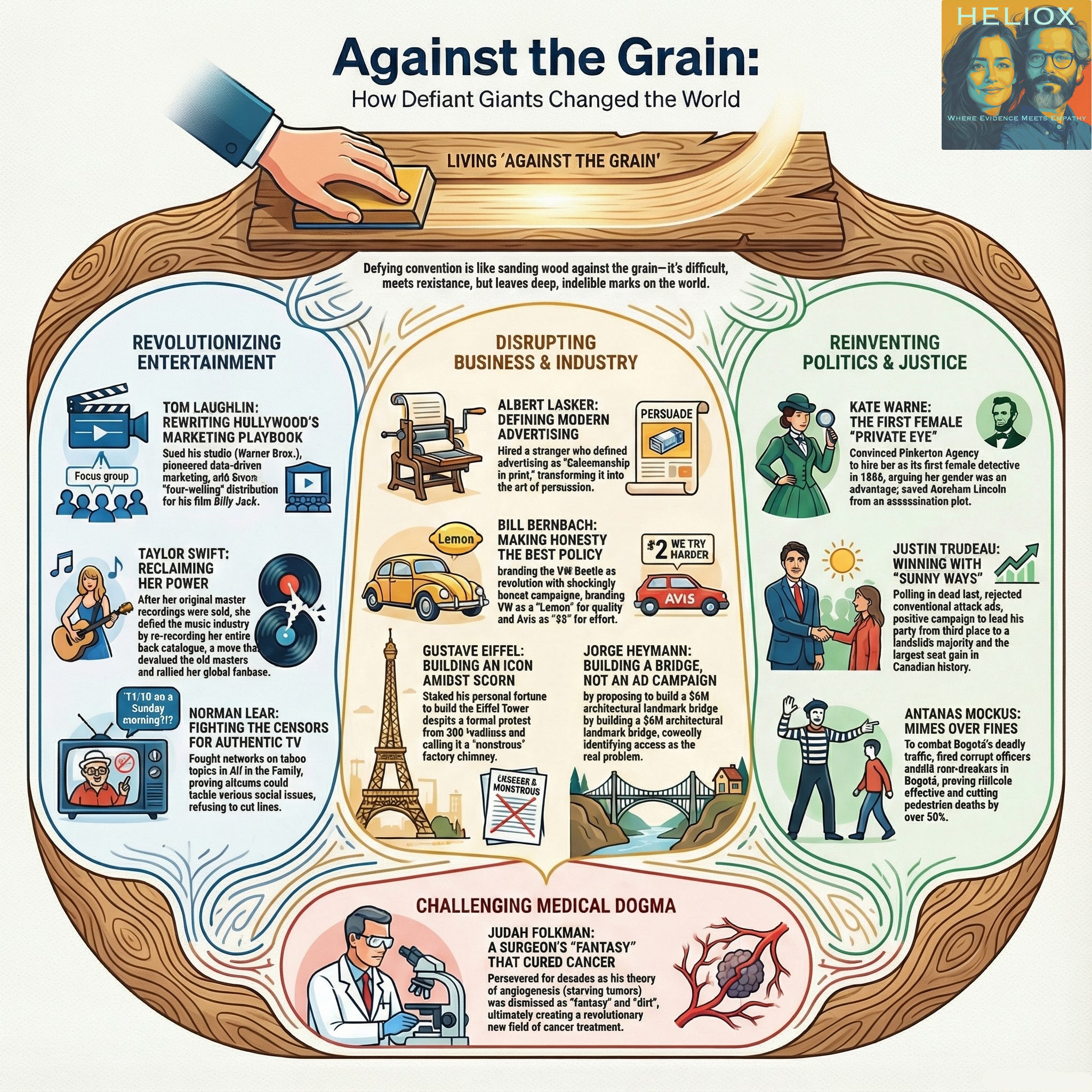
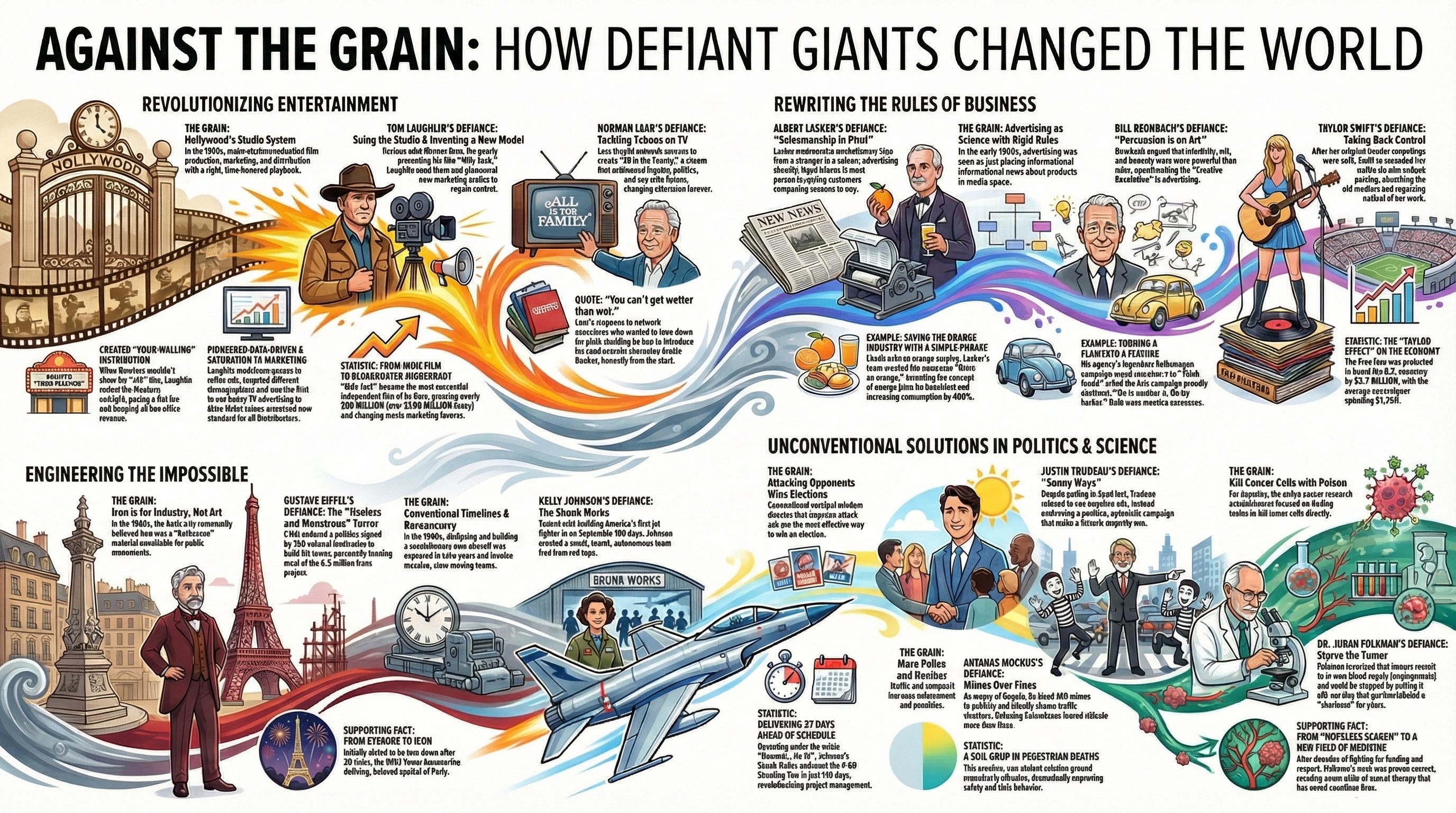
Really strong compilation here. The Lasker-Sunkist example of creating the entire concept of 'orange juice' as a daily staple is wild when you think about reframing a surplus problem into a consumer habit. I remember hearing how most households barely touched citrus outside of special occassions before that campain. The way you layered these stories shows how every 'new grain' eventually becomes the next thing that neeeds challenging.