Alone Together: The Multi-Layered Crisis of Solo Living
In the second-most gender-equal nation in the EU, women still perform more of the household labor per day than men. Over a 30-year marriage, that is more than 15 full 24-hour days of stolen time.

With every article and podcast episode, we provide comprehensive study materials: References, Executive Summary, Briefing Document, Quiz, Essay Questions, Glossary, Timeline, Cast, FAQ, Table of Contents, Index, Polls, 3k Image, Fact Check, at the very bottom of the page.
Soundbite
Essay
There is a particular kind of loneliness that wears good taste like a disguise.
Picture Denmark — or rather, picture the Denmark we have been sold. Cobblestone streets soft with evening light. A bicycle propped against a building the color of old amber. Inside, through a window framed in wood, the warm flicker of candles. Hygge. The very word is now an international export, a lifestyle brand, a promise that somewhere in Northern Europe, human beings have figured out the quiet art of being cozy together.
And then the number arrives, and it breaks the picture in half.
Forty-six percent.
Nearly half of all Danish households contain exactly one person. One set of dishes. One heating system running through long winter nights. One door that opens and closes without negotiation, without compromise, without the beautiful irritation of another human being leaving their mug on the counter. Denmark — that celebrated utopia of togetherness, that civilization we look to as proof that human beings can genuinely prioritize collective well-being — is a nation where nearly half the homes are inhabited by a single soul.
When researcher Tulia Jack set out to understand this, she did something radical by the standards of contemporary social science: she went to people’s homes. She sat on their couches. She drank their coffee. She asked them, with patience and genuine curiosity, how they had arrived here — not statistically, but humanly. What sequence of choices, market failures, heartbreaks, and cultural inheritances had deposited them in these solitary rooms?
What she found was not the triumphant independence the cultural script promises.
It was, mostly, an accident.
The young professionals who relocated for careers and found no infrastructure for finding flatmates. The mid-lifers who had once enjoyed the warm chaos of shared apartments but gradually aged out of it — because somewhere in our social imagination, communal living is for students, and moving past it alone is what adulthood looks like. The older women, and this is where the story gets genuinely political, who had fought through decades of what sociologists call the second shift — the invisible, uncounted, relentless labor of cooking and managing and emotionally sustaining — and had finally, at great personal cost, bought themselves a room of their own. Not as a metaphor. As a literal act of liberation.
Gertrude is 78. Susan is 54. Liv is 62 and divorced, and she described her marriage with a precision that could have been a line from Doris Lessing: I was free when I lived with him, but not free enough.
Not free enough. The phrase lands like a quiet verdict on the entire project of heterosexual domesticity. Not a story of obvious cruelty or dramatic collapse, but of the low-level permanent tether — the ambient expectation that she would notice when the milk was low, that she would manage the family calendar, that she would absorb the emotional weather of the household while also working a full day elsewhere. In Denmark, the most gender-progressive nation in the EU outside of Sweden, women still perform nearly an hour more of household labor per day than men. Across a 30-year marriage, that is more than fifteen full 24-hour days of stolen time, per year.
Women are not retreating into solo apartments because they are antisocial. They are retreating because the alternative has been structured, for generations, to cost them more than it costs anyone else.
And this is where the study refuses to stay politely in its lane.
Because living alone, it turns out, is not just a social phenomenon. It is a climate crisis in slow motion.
A solo dweller in Denmark generates 13 tons of carbon emissions annually. The national average is 9. Those four extra tons represent the fundamental inefficiency of duplicated infrastructure — one heating system per person, one refrigerator, one washing machine, empty rooms burning fossil fuels to maintain a temperature of comfort for nobody. When 46% of households contain only one person, the aggregate environmental cost is staggering, and growing, and barely mentioned in any mainstream conversation about climate mitigation.
Here is the brutal geometry of the modern condition: the systems that have pushed people toward isolation — a broken housing market, rigid cultural expectations of adulthood, the unequal distribution of domestic labor — have also, quietly, been cooking the planet.
But there is a reason this essay does not end in despair.
Because alongside the statistics and the policy failures, Tulia Jack also asked people to imagine. And a 36-year-old named Skye described a vision so coherent and lovely it deserves to be called a plan rather than a dream: an ælde kollektiv, an elder collective, where friends pool resources to buy a building together. Each person has their own private room — the crucial sanctuary, the door that locks, the space that belongs entirely to them. But the rest is shared: a communal kitchen, a workshop, a café on the ground floor. Passive social capital built directly into the architecture, available without scheduling, without performance, without the exhausting friction that currently drives people apart.
The barriers to building such a thing are immense. Zoning laws. Bank financing structures. A cultural assumption that unrelated adults sharing a building are somehow failing. But the barriers are structural, not human. We built this road. We can build different ones.
The researcher proposes what she calls the SHARE framework: financial incentives for co-living, tax breaks for renting spare rooms, matching platforms to reduce the friction of finding compatible housemates, and — this is the part that requires real courage — a deep, serious reckoning with the gendered division of domestic labor. Because you cannot solve the carbon footprint of housing without solving what happens at the kitchen sink. Women will continue to rationally choose solitude over the second shift until men genuinely, measurably do half the work.
This is what evidence-based empathy looks like when you follow it all the way down. A demographic statistic in Denmark leads to a woman’s quiet declaration of freedom leads to an architectural blueprint for community leads to the unavoidable conclusion that climate policy is also, inescapably, gender policy.
The windows in those Danish apartments are still glowing tonight. Behind half of them, someone is eating dinner alone, heating a room for one, managing a life that the infrastructure of our civilization has made it extraordinarily easy to live in isolation.
We are not, as the podcast closes by suggesting, natural hermits. We are people who have been handed a map with only one road on it.
The question is not whether we can do better. The question is whether we have the imagination — and the will — to build the bike lanes.

References
Why we live alone—and what it means for the climate and our sense of community
Other Links to Heliox Podcast
YouTube
Substack
PRX ( Public Radio Exchange)
Podcast Providers
Spotify
Apple Podcasts
Patreon
FaceBook Group
STUDY MATERIALS
Briefing
Executive Summary
Solo living is a rapidly accelerating global trend, with Denmark serving as a primary case study where nearly half (46%) of all households are single-occupancy. This briefing document synthesizes research into the social dynamics, environmental impacts, and gendered experiences of those living alone.
The core findings reveal a significant “sustainability paradox”: while solo living offers personal autonomy, it results in higher per-capita resource consumption and exacerbates the housing crisis through under-occupancy. The transition to solo living is rarely a singular choice but occurs through four distinct pathways: urban relocation, “aging out” of shared housing, empty nests, and active solitude-seeking.
Crucially, the experience of solo living is deeply gendered. Women often view living alone as an emancipatory escape from unequal domestic labor, while men frequently experience it as a stigmatized, temporary “limbo” phase. Despite the trend, many solo dwellers are open to future shared living arrangements, suggesting that policy interventions—specifically the “SHARE” framework—could reduce carbon footprints and enhance social well-being by facilitating communal housing models.
--------------------------------------------------------------------------------
The Sustainability Paradox
The rise of solo living presents a critical challenge for climate mitigation and urban planning. Single-occupancy households are less efficient than shared residences in several key metrics:
Carbon Footprint: Single householders in Denmark have a mean carbon footprint of 13.0 tonnes CO2e per year—4 tonnes higher than the national average. Per capita, solo dwellers have double the carbon footprint of those in households with five or more people.
Resource Consumption: Solo living requires individual sets of appliances and consumer products, leading to higher per-capita energy consumption and waste generation.
Under-occupancy: Many solo dwellers occupy large residences (mean size 71 m2) with unused “spare rooms” that require heating, maintenance, and construction, contributing to European housing shortages.
--------------------------------------------------------------------------------
Pathways to Solo Living
The study identifies four primary clusters of individuals who end up living alone, highlighting that solo living is often a life stage rather than a permanent identity.
1. Urban Transplants
These are often highly skilled, mobile individuals (internationals or Danes moving between cities) who relocate for work. Despite a preference for sharing, they end up living alone due to a lack of social networks and intense competition for rental properties in urban centers like Copenhagen.
2. “Aging Out”
This group consists of adults who previously enjoyed shared living (collectives or student housing) but eventually feel that shared dynamics—such as negotiating chores or lack of privacy—are no longer appropriate for their life stage. They often drift into solo living because they feel they should have their “own” space as “proper” adults.
3. Empty Nesters
Individuals whose children have moved out or who have experienced a divorce/death of a spouse. These residents often remain in large family homes, demonstrating the influence of nuclear family cultural norms and the lack of visible senior co-housing alternatives.
4. Solitude Seekers
The only group that actively and intentionally chooses solo living. These individuals prioritize control over their environment and energy. Notably, several participants cited mental health stability and the need to manage social stimulation as primary drivers for living alone.
--------------------------------------------------------------------------------
The Gendered Divide: Emancipation vs. Stigma
A striking disparity exists in how men and women perceive and navigate solo living.
Feature
Women’s Experience
Men’s Experience
Primary Sentiment
Emancipatory: Freedom from domestic and emotional labor.
Stigmatizing: Viewed as a temporary or “failed” stage.
Motivation
Reluctance to return to unequal household divisions (women spend ~1 hour more on chores daily).
Hope for a future partner; many live in larger homes as a “bargaining chip.”
Housing Status
More likely to rent (especially younger women), allowing for future flexibility.
More likely to own (9 out of 11 surveyed), “locking in” current solo status.
Social Recruitment
Highly responsive and candid in sharing experiences.
Difficult to recruit; expressed “social awkwardness” or unease with participation.
Insights on the Gender Gap
Independence: Older women, particularly those who are divorced or widowed, express a “fierce independence” and a refusal to take on caregiving roles for a new male partner.
The “Limbo” State: Men often view their current solo residence as a placeholder for a future nuclear family, with one participant describing his 120 m2 apartment as an “imagined bargaining chip” for a potential partner.
--------------------------------------------------------------------------------
Social Capital and Loneliness
Solo living impacts social capital—the networks of relationships that allow a society to function effectively.
Passive vs. Active Capital: Solo dwellers lack the “passive” social capital accumulation that comes with cohabitation. They must expend significant energy to maintain networks (e.g., hosting BBQs, traveling to see friends).
Service Reliance: Many participants rely on technology-based services (like Uber or delivery apps) for practical help rather than neighbors or friends, which may indicate a thinning of local community ties.
Unintentional Loneliness: While many enjoy their independence, they also express uncertainty about who would help them with practical tasks, signaling lower social capital than those in shared arrangements.
--------------------------------------------------------------------------------
Future Imaginaries: Aging in Place
Visions of the future depend largely on age and current housing stability:
Over 50s: Predominantly intend to “age in place” in their current homes, expecting municipal assistance for future mobility or health issues.
Under 50s: Show more romanticized interest in “elder collectives” (olle kolles) or buying multi-story buildings with friends to share resources while maintaining private spaces.
--------------------------------------------------------------------------------
Policy Recommendations: The SHARE Framework
To address the environmental and social challenges of solo living, the study proposes the SHARE framework to make communal living more viable and attractive.
S—Structural Support: Expand co-housing and co-living options through financial incentives and regulatory flexibility.
H—Housing Stock: Harness under-occupied space by encouraging homeowners to take in tenants or repurpose rooms through tax incentives and grants.
A—Advance Acceptance: Use public awareness campaigns to normalize co-living and reduce the stigma of sharing as an adult.
R—Rebalance Gender Roles: Address the “care gap” through equal parental leave and initiatives that encourage equitable distribution of household duties, making shared living more appealing to women.
E—Ensure Inclusivity: Respect diverse needs, including those who live alone for mental health reasons, ensuring policies do not penalize those for whom sharing is not an option.
Conclusion
The rise of solo living in Denmark is a complex phenomenon driven by economic independence and shifting life paths. While it offers a sense of freedom—particularly for women—the resulting environmental and social costs are substantial. By focusing on shared housing models and addressing gendered labor imbalances, policymakers can transform solo living from a sustainability challenge into an opportunity for more resilient, low-carbon communities.
Quiz & Answer Key
What is the current prevalence of solo living in Denmark according to recent statistics?
How does solo living impact an individual’s carbon footprint compared to larger households?
What characterizes the “urban transplant” pathway to solo living?
Why do some individuals choose to “age out” of shared living arrangements?
How do gender differences manifest in the perception of solo living among women?
In what ways does the male experience of solo living often involve social stigma or “lost potential”?
What is the relationship between solo living and social capital accumulation?
What are the common future housing preferences for solo dwellers over the age of fifty?
How do younger solo dwellers, particularly urban transplants, envision their future living arrangements?
What is the “SHARE” framework proposed in the research?
--------------------------------------------------------------------------------
Part II: Quiz Answer Key
What is the current prevalence of solo living in Denmark according to recent statistics? In Denmark, nearly half of all households (46%) are single-occupancy dwellings, placing the country among the global leaders in this trend. Within this demographic, women represent 26% of solo households while men represent 20%.
How does solo living impact an individual’s carbon footprint compared to larger households? Solo living significantly increases per capita resource consumption, as single occupants typically have their own sets of appliances and higher energy and waste patterns. Research indicates that single householders have double the average per capita carbon footprint of those living in households of five or more people.
What characterizes the “urban transplant” pathway to solo living? Urban transplants are often highly skilled, career-driven individuals who relocate for work and end up living alone due to a lack of established local networks. While many in this group have had positive past experiences with shared living, they frequently default to solo occupancy because they cannot find suitable cohabitation opportunities in competitive housing markets.
Why do some individuals choose to “age out” of shared living arrangements? Individuals “age out” when they begin to view shared housing as a temporary life stage that is no longer appropriate or “proper” for adults. This shift is often driven by a desire for more space and a growing intolerance for the daily negotiations, compromises, and potential conflicts inherent in living with others.
How do gender differences manifest in the perception of solo living among women? Many women view solo living as an emancipatory experience that offers freedom from the unequal distribution of domestic and emotional labor found in heterosexual relationships. This independence is often associated with a sense of pride and the ability to focus on personal pursuits without the burden of caregiving responsibilities.
In what ways does the male experience of solo living often involve social stigma or “lost potential”? Men in the study often viewed solo living as a temporary stage and expressed a desire for future cohabitation with a partner. Many lived in larger apartments than they currently needed, viewing the extra space as a “bargaining chip” for a future family, and expressed melancholy over the “lost potential” of not living in a nuclear family structure.
What is the relationship between solo living and social capital accumulation? Solo dwellers generally lack the passive social capital accumulation that comes with cohabitation and must invest significant active energy into maintaining social networks. Some participants reported relying on technology-based services, such as Uber, for practical help rather than relying on friends or neighbors.
What are the common future housing preferences for solo dwellers over the age of fifty? Older participants who have lived in their residences for long periods generally prefer to “age in place” to maintain their independence. They typically view institutional settings like retirement villages as a last resort and expect municipal services to provide assistance in their current homes when necessary.
How do younger solo dwellers, particularly urban transplants, envision their future living arrangements? Younger solo dwellers often romanticize future communal living, such as “olle kolle” (elder collectives), where they could live near friends or siblings in socially engaged environments. This preference is most common among those who currently lack deep roots in their solo dwellings and see living alone as a flexible, temporary life stage.
What is the “SHARE” framework proposed in the research? The SHARE framework is a set of policy principles designed to make shared living more attractive and accessible: Structural support/incentives, Harnessing under-occupied stock, Advancing acceptance, Rebalancing gender roles in domestic work, and Ensuring inclusivity and choice.
Essay Questions
The Sustainability Paradox of Modern Living: Analyze how the trend toward independent solo living directly conflicts with global climate mitigation goals. Discuss the specific resource pressures created by single-occupancy households.
Gendered Pathways to Solitude: Compare and contrast the “emancipatory” view of solo living held by women with the “stigmatized” view often held by men. How do societal expectations of domestic labor and the “provider” role shape these perspectives?
The Role of Policy in Social Engineering: Evaluate the proposed SHARE framework. To what extent should governments intervene in housing choices to address “under-occupancy” and promote shared living for environmental reasons?
Social Capital and the “Service” Economy: Discuss the shift from passive social capital (shared housing) to active social capital maintenance. How does the reliance on technology-based services affect community resilience for those living alone?
Life Course Transitions and Housing: Examine the four pathways to solo living (urban transplants, aging out, empty nests, and solitude seeking). How do these categories challenge the idea that living alone is always a proactive, permanent choice?
Glossary of Key Terms
Aging in Place
The preference of older adults to remain in their current private residence for as long as possible, rather than moving to institutional care.
Aging Out
A transition where individuals move from shared to solo living because they feel cohabitation is no longer age-appropriate or “proper” for adults.
Carbon Footprint
The total amount of greenhouse gases (including carbon dioxide and methane) generated by an individual’s actions and household consumption.
Elder Collective (Olle Kolle)
A communal or shared living arrangement specifically designed for older adults to provide social engagement and mutual support.
Empty Nesters
Individuals who live alone after their children have grown up and moved out of the family home.
Living Apart Together
A relationship model where partners maintain a committed relationship but choose to live in separate residences.
Second-hand Contract
A rental agreement where a subtenant rents from a primary leaseholder rather than directly from the property owner, often resulting in fewer legal protections.
SHARE Framework
A policy principle acronym standing for Structural support, Housing stock, Advance acceptance, Rebalance gender roles, and Ensure inclusivity.
Social Capital
The networks of relationships among people who live and work in a particular society, which enable that society to function effectively.
Solitude Seekers
Individuals who actively and intentionally choose to live alone due to a preference for personal space, control over their environment, or mental health needs.
Under-occupancy
A housing situation where a dwelling has more habitable rooms (such as spare bedrooms) than are necessary for the number of occupants.
Urban Transplants
Mobile, often highly skilled individuals who relocate to cities for career reasons and end up in solo living arrangements due to a lack of local social networks.
Cast of Characters
1. The Macro-Landscape: Denmark as a Global Leader in Solo Living
Denmark currently serves as the global vanguard for the solo living trend, with 46% of all households consisting of a single occupant. While this demographic shift reflects a society with the economic prosperity and social safety nets required to support individual autonomy, it presents a profound strategic tension. The rise of single-occupancy living is a primary driver of high per-capita resource consumption, creating an environmental urgency that outweighs the benefits of technological innovation. Quantitative analysis reveals a stark baseline: solo dwellers in Denmark produce a mean carbon footprint of 13.0 tonnes of CO2e—a figure that stands in sharp contrast to the national average of 9 tonnes.
This footprint is anchored in the physical reality of under-occupancy. Solo individuals occupy a mean dwelling size of 71m², with some single residents navigating spaces as large as 120m². As the number of households increases faster than the population, the pressure on housing markets and the climate intensifies, transforming the private choice to live alone into a critical matter of public policy. To address this, we must look beyond the statistics and into the specific life-course transitions—the “cast of characters”—that define the solo experience.
2. Character Group A: The Urban Transplants
The “Urban Transplant” archetype is shaped by the strategic demands of high-skilled mobility. In an increasingly globalized labor market, professionals frequently relocate for career advancement, only to experience an “unintended slide” into solo living. While these individuals often possess high social capital, the logistical barriers of a new city often override their desire for community. In Denmark’s competitive urban centers, solo living becomes a default rather than a primary goal, as the “friction” of finding compatible shared housing is simply too high.
The experiences of Lina and Eric illustrate these systemic barriers. Lina, who moved to Esbjerg for work, actively sought a collective living situation through social networks but was forced into solo living when no suitable options emerged. In Copenhagen, Eric’s attempt to start a flat-share was thwarted by a housing crisis characterized by 200-person queues for viewings and restrictive second-hand contracts that prohibited cohabitants. For this group, solo living is framed as a “temporary phase,” yet it persists because they are effectively trapped by market competition and a lack of institutional support for social integration.
Key Differentiators of Urban Transplants:
High Social Capital vs. Low Local Opportunity: They possess strong professional skills but lack the established local networks required to navigate “vouching” systems in shared housing.
Market-Driven Isolation: Their solo status is a result of rental market scarcity and restrictive leasing laws rather than an active rejection of others.
Intentional Openness: Despite their current isolation, they maintain a functional base for their career while remaining open to future cohabitation if the “friction” of entry is reduced.
3. Character Group B: The Age Outers
The “Age Outer” group highlights the power of cultural norms regarding “proper” adult living. In Denmark, while shared living is a rite of passage for students, a subtle social stigma attaches to collective living as one reaches middle age. For individuals like Folke and Nina, the transition to solo living is a pursuit of domestic sovereignty and a rejection of the “daily negotiations” of shared life.
The distinction here is between the enjoyment of shared history and the practical burden of current cohabitation. Folke, after twenty years of living in collectives, reached a lifecycle breaking point where shared living was “not good enough” anymore, citing an urgent need for more personal room. Nina echoed this fatigue, noting that after twelve years of renting out a spare room, she was “fed up” with negotiating over domestic labor and cleaning schedules. For Age Outers, the autonomy to manage one’s own environment is viewed as a hallmark of successful adulthood, leading them to prioritize private dwellings despite the increased financial and environmental costs.
4. Character Group C: The Empty Nesters and Senior Solos
Solo living in later life is often a byproduct of the “hegemony of nuclear family norms,” which leaves a vacuum of shared-living models for older demographics. When the family unit dissolves, individuals are frequently left “aging in place” within large residences designed for multiple occupants. This creates a significant strategic opportunity for housing reform, as this group represents a massive concentration of under-occupied space.
Chris: After his sons moved into their own apartment, he remained in a 100m² dwelling, viewing the prospect of moving as “too much hassle.”
Gertrud and Val: These women (aged 78 and 90, respectively) illustrate the trend of staying in large residences (up to 120m²) for decades after their partners have passed.
There is a notable lack of intentionality in this group’s solo status; many simply stayed in their homes because senior co-housing remains a rare and under-promoted alternative. Val’s experience of navigating a 120m² house alone at age 90 highlights the failure of the market to provide “pragmatic” communal alternatives that would allow seniors to downsize without losing social connection.
5. Character Group D: The Solitude Seekers
Unlike those who “drift” into solo living, “Solitude Seekers” actively prioritize isolation as a vital tool for agency and well-being. For these individuals, solo living is a strategic requirement for emotional stability and environmental control. This group defines solo living not as a deficit of social contact, but as a protective refuge.
The accounts of Ella and Susan define this active rejection of cohabitation. Ella seeks solo living to avoid being “distracted by other people’s energies,” while Susan, despite a long-term partnership, lives alone to protect her time and space. Crucially, this group reveals two critical strategic findings:
The Labor Refuge: Women often seek solo living specifically to escape the “domestic and emotional labor” inherent in heterosexual partnerships, viewing living alone as a triumph of independence.
The Mental Health Anchor: For some, solo living is a non-negotiable requirement for managing mental health symptoms. This is a core sociological insight: the ability to control social stimulation and domestic predictability is a primary mechanism for psychological stability that shared housing cannot currently guarantee.
6. The Gendered Experience: Emancipation vs. Stigma
Gender shapes the perception and performance of solo living in Denmark. For women, living alone is often a hard-won liberation from caregiving roles. For men, it is more frequently associated with social stigma and “lost potential,” where the home is a “waiting room” for a future family.
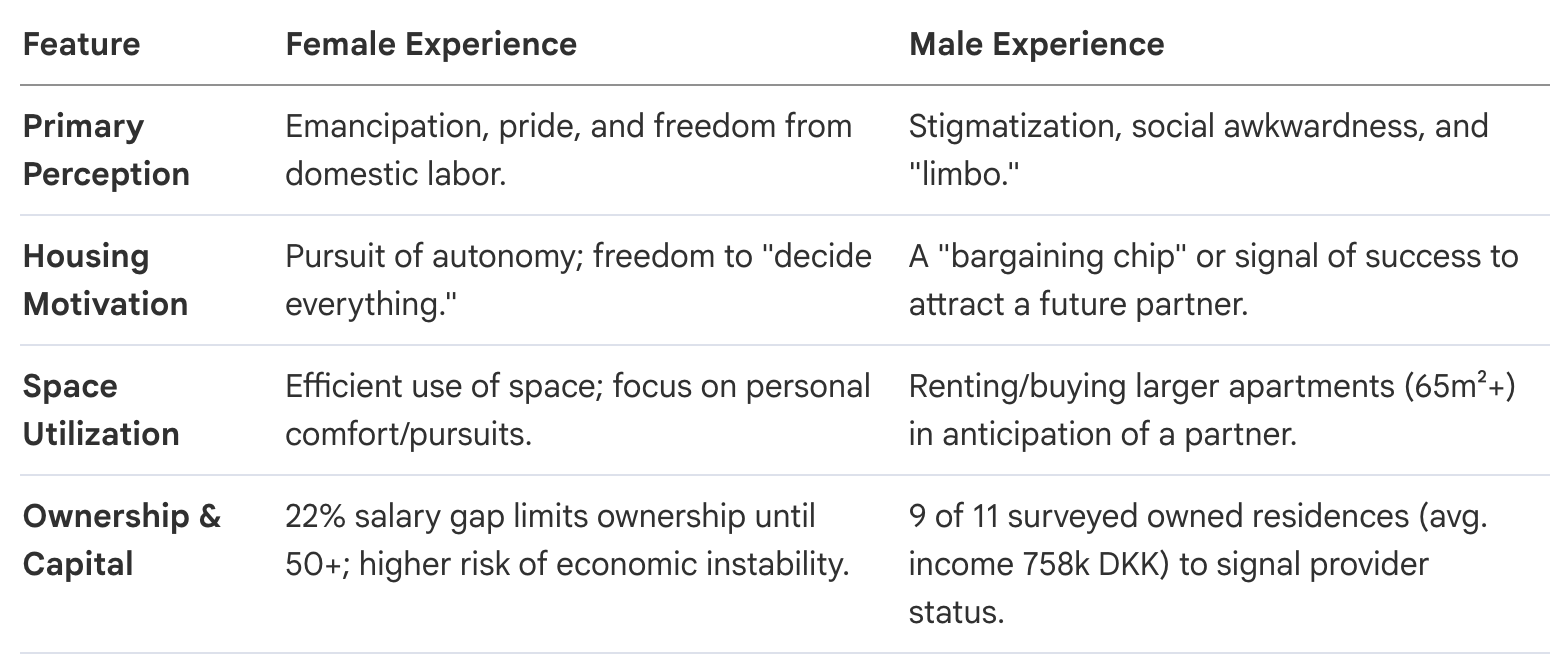
This “Salary Gap” (758,280 DKK for men vs. 622,633 DKK for women) dictates that men use larger residences as “bargaining chips” for future relationships, while women, though more emotionally satisfied in solo living, face greater long-term economic vulnerability.
7. Future Imaginaries and the SHARE Policy Framework
The “habitation horizon” is split by age: younger transplants maintain romanticized visions of “elder collectives” (olle kolle), while older residents remain pragmatic, intending to “age in place” until municipal assistance is required. To bridge these visions and address the environmental impact of 13.0-tonne footprints, the SHARE framework provides a roadmap:
Structural Support: Expand co-housing and house-sharing options through financial incentives, regulatory flexibility, and practical assistance for new residents.
Housing Stock: Harness under-occupied space by capping the number of rooms per occupant in public housing and providing tax incentives for homeowners to take on live-in tenants.
Advance Acceptance: Launch public awareness campaigns to normalize co-living and deploy matching platforms to reduce the social friction of finding compatible housemates.
Rebalance Gender: Rebalance domestic labor by mandating equal parental leave and providing affordable care services to prevent women from fleeing to solo living as a refuge from unpaid work.
Ensure Inclusivity: Design policies that respect individual needs for solitude, ensuring those with mental health considerations or sensory needs are not marginalized by sharing initiatives.
Shared living represents the “low-hanging fruit” of global sustainability. By addressing the social dynamics of the Danish “cast of characters,” policymakers can reduce carbon footprints while enhancing the social capital and well-being of an increasingly isolated population.
FAQ
1. Introduction to the Solo Living Phenomenon
Denmark is currently navigating a profound demographic transformation that has placed it at the vanguard of a global shift toward single-occupancy living. This trend is not merely a statistical curiosity; it represents a critical strategic nexus where the intensifying global housing crisis intersects with national climate mitigation imperatives. As urban centers face chronic housing shortages, the proliferation of under-occupied dwellings emerges as a primary structural barrier to achieving sustainability targets. To understand this, we must move beyond aggregate demographic counting to a more sophisticated sociological inquiry.
By synthesizing the micro-level narratives of individual life-course transitions with macro-level environmental data, we can identify how personal habitation choices aggregate into a significant “per capita” resource utilization discrepancy. The following frequently asked questions explore the core drivers of this shift, the gendered dynamics of under-occupancy, and the potential for innovative policy frameworks to align residential living with planetary boundaries.
--------------------------------------------------------------------------------
2. FAQ Part I: Demographics and Environmental Footprints
The intersection of household scale and resource intensity is a vital variable in national sustainability strategies. Shared living models fundamentally allow for the pooling of carbon-intensive infrastructure, whereas the rise of the solo dweller necessitates a redundant expansion of energy, land, and material consumption.
What is the current scale of solo living in Denmark, and how does it compare globally?
Denmark currently maintains one of the highest rates of solo living in the world, with 46% of all households consisting of a single occupant. This trend is characterized by a notable gender asymmetry: 26% of Danish households are comprised of women living alone, while 20% are men. This puts Denmark at the lead of a broader European Union trajectory where economic independence and shifts in relationship patterns have decoupled the “household” from the traditional “nuclear family” unit.
Why is solo living considered a significant environmental challenge compared to shared living?
Solo living presents an inherent “per capita” resource utilization discrepancy. Because individual dwellers do not share appliances, heating, or common living areas, their environmental footprint is disproportionately high. On average, a solo dweller in Denmark generates 13.0 tonnes of CO2e annually—a full 4 tonnes higher than the national average of 9 tonnes.
The efficiency gap is most stark when compared to the most sustainable residential models, as illustrated below:
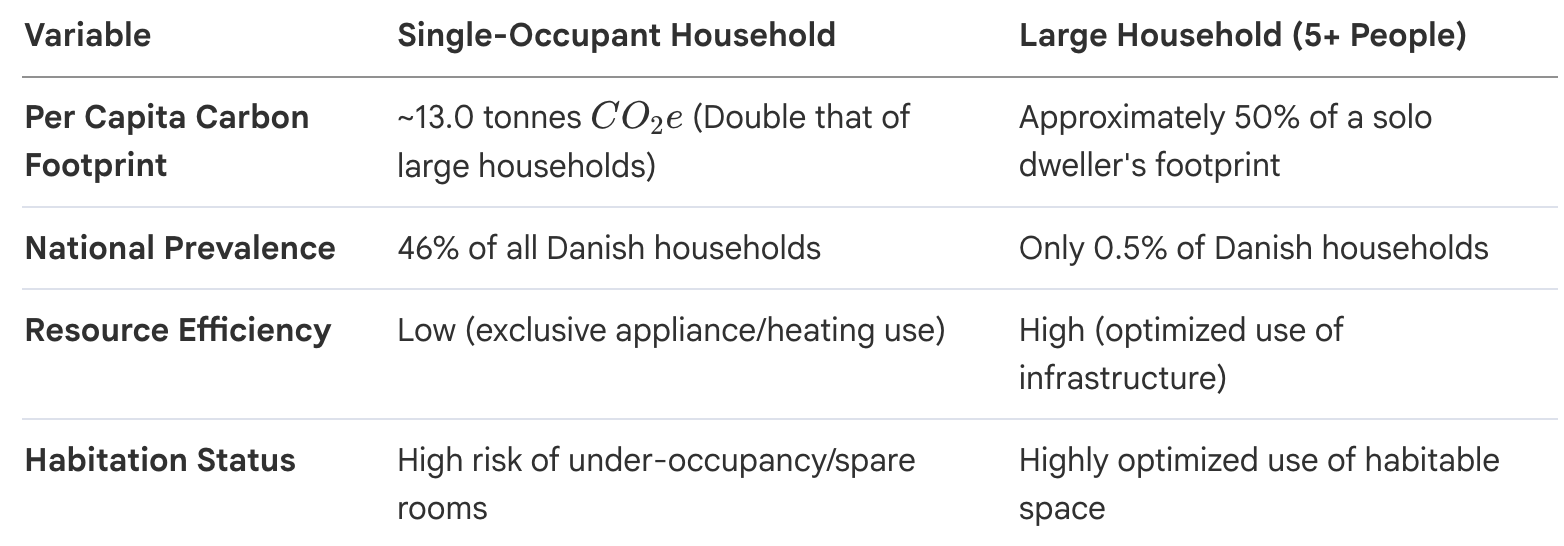
This discrepancy underscores why carbon reduction cannot be achieved through technological innovation alone; it requires addressing the sociological pathways that lead to high-impact solo dwelling.
--------------------------------------------------------------------------------
3. FAQ Part II: Pathways and Social Dynamics
Effective policy must be grounded in “micro-level narratives” that distinguish between intentional and unintentional solo living. This distinction is vital for understanding the erosion of social capital and the structural barriers to cohabitation.
What are the four primary pathways leading individuals to solo living?
Sociological analysis identifies four distinct clusters of solo dwellers:
Urban Transplants: Highly skilled professionals relocating for career opportunities.
Challenges: Navigating high-competition rental markets and the absence of established local social networks.
Age Outers: Individuals transitioning away from shared student housing or collectives.
Challenges: A perceived need for “environmental control”; a cultural shift viewing shared dynamics as “unprofessional” or burdensome for mature adults.
Empty Nesters: Older adults whose children have departed or who have lost a partner.
Challenges: Resistance to the “hassle” of downsizing; maintaining oversized, under-occupied family homes.
Solitude Seekers: Individuals who actively choose solo living for mental health, autonomy, or to avoid domestic labor.
Challenges: Mitigating potential social isolation while maintaining strict boundaries for personal space.
To what extent is solo living an active choice versus a result of circumstance?
For many, solo living is an “unintentional” default dictated by market pressures. For example, individuals like Eric and Lina express a latent desire for shared living but are thwarted by structural barriers. Eric reported being dissuaded by extreme competition in Copenhagen—where viewings attract hundreds—and was ultimately bound by a second-hand lease contract that strictly forbade inviting housemates. Similarly, Lina’s attempts to find collectives were limited by a lack of visible sharing networks in her new city. This suggests that the housing market often forces individuals into isolated units against their social preferences.
These pathways are further complicated by hegemonic gender norms, which dictate how solo living is perceived and practiced.
--------------------------------------------------------------------------------
4. FAQ Part III: Gender, Stigma, and Social Capital
Gender roles and cultural expectations regarding independence and caregiving create divergent experiences of solo life, influencing the long-term sustainability of the housing stock.
How do gender roles influence the perception of solo living as “emancipatory” or “stigmatizing”?
There is a profound gender divide in the “habitation imaginaries” of solo dwellers. For many women, living alone is an emancipatory act. It provides a sanctuary from the “domestic and emotional labor” typically expected in heterosexual partnerships, with participants expressing pride in “moving in with themselves.”
In contrast, men often view solo living through a lens of stigma or melancholy. This has direct environmental consequences: men in the study were significantly more likely to own larger residences (9 out of 11 men vs. 3 out of 12 women) as an “imagined bargaining chip” to attract a future partner. Supported by a 22% higher average disposable income, men often maintain these under-occupied family-sized homes in perpetuity. This “perpetual under-occupancy” paradigm represents a significant waste of habitable space and a barrier to carbon reduction.
What is the relationship between solo living, loneliness, and social capital?
Solo dwellers must transition from “passive social capital accumulation” (the incidental social contact of shared living) to “active maintenance.”
Active Maintenance: High-social-capital individuals must intentionally invest energy in hosting, clubs, and festivals to prevent isolation.
Compensatory Mechanisms: Solo dwellers increasingly rely on gig-economy platforms (e.g., Uber) to fulfill practical needs that would traditionally be managed by cohabitants.
Recruitment Bias: It is important to note that because research often relies on “snowballing” recruitment, current data may actually reflect an optimistic bias; the general solo-living population likely experiences even higher levels of social capital erosion than reported.
These social realities deeply influence whether individuals are willing to consider future shared living arrangements.
--------------------------------------------------------------------------------
5. FAQ Part IV: Future Imaginaries and Policy Interventions
Forward-looking policy must address the “acclimatization” effect: the longer an individual lives alone, the less inclined they become to share space. Early intervention is therefore critical.
How do future living preferences shift across the life course?
Preferences generally bifurcate by age:
Aging in Place: Older owners, especially those who have “acclimatized” to solo life, prefer to stay in their homes until they require municipal care, viewing downsizing as a loss of independence.
Elder Collectives (”Olle Kolle”): Younger renters often romanticize communal living for their senior years, imagining buildings with shared cafes and integrated social support.
What is the “SHARE” framework, and how can it mitigate the impacts of solo living?
The SHARE framework provides a strategic toolkit for policymakers to rebalance the housing market and reduce environmental impacts:
S—Structural Support: Expand co-housing and house-sharing options through financial incentives and regulatory flexibility for developers.
H—Housing Stock: Harness under-occupied space via tax incentives for renting out spare rooms and, more radically, capping the number of rooms per occupant in public housing to ensure equitable space distribution.
A—Advance Acceptance: Utilize matching platforms and public awareness campaigns to normalize co-living as a mainstream residential choice for all ages.
R—Rebalance Gender: Implement equal parental leave and affordable care services; by equalizing the domestic labor burden, policy makes shared living more attractive to women who currently flee it to avoid unpaid work.
E—Ensure Inclusivity: Ensure that co-living models are adaptable and respect the needs of those who require solo living for mental health or personal stability.
In conclusion, shared living represents the “low-hanging fruit” for both carbon reduction and social wellbeing in Denmark, provided that policy can dismantle the structural and cultural barriers that keep us living apart.
Table of Contents with Timestamps
I. THE POSTCARD AND THE STATISTIC 0:25 A guided visualization of the Denmark we imagine — bicycles, hygge, candlelight, pastries — dismantled by a single jarring number: 46% of Danish households contain exactly one person.
II. THE STUDY: GOING DEEP 4:10 Introduction to researcher Tulia Jack and her 2026 qualitative study. Why sitting in people’s living rooms — not parsing spreadsheets — is the only way to understand a phenomenon this human.
III. PATHWAYS INTO SOLITUDE 7:30 The four routes by which people arrive at solo living — almost never by deliberate choice. The urban transplants (Lena, Eric), the age-outers (Nina, Folk), the empty nesters, and the solitude seekers (Ella). An examination of market failure, cultural conditioning, and the rare, genuine preference for aloneness.
IV. THE GENDERED EXPERIENCE OF SILENCE 18:00 For women, the solo apartment is a sanctuary won at significant cost — escape from the second shift and decades of invisible domestic labor. For men, it is more often a waiting room, a temporary embarrassment, a space haunted by the life script that never arrived. The stories of Gertrude, Susan, Liv, and the heartbreaking case of Peter and his 120 square meter apartment.
V. THE HIDDEN COSTS: SOCIAL CAPITAL AND CARBON 31:00 Solo living quietly collapses the passive social capital that keeps people connected without effort. Simultaneously, it drives an environmental crisis: solo dwellers produce 13 tons of CO₂ annually versus a national average of 9 — and single householders carry double the per capita carbon footprint of those in five-person households.
VI. IMAGINING DIFFERENTLY: THE ÆLDE KOLLEKTIV 41:00 Skye’s vision of an elder collective — private rooms within a shared building — as a model that resolves both the friction of cohabitation and the inefficiency of isolation. Why it is structurally, not humanly, impossible right now.
VII. THE SHARE FRAMEWORK 47:00 A policy blueprint for making shared living the path of least resistance: financial incentives, regulatory reform, tax breaks for spare rooms, matching platforms, and — crucially — the inseparable link between gender equity in domestic labor and climate policy.
VIII. THE BIKE LANES ANALOGY AND CLOSING REFLECTION 56:00 Why asking people to share isn’t enough if we haven’t built the social infrastructure for it. A final question left with the listener: who would you invite into your spare room if you knew the dishes would always be done fairly?
Index with Timestamps
ælde kollektiv (elder collective), 41:00, 47:00 age-outers (demographic group), 18:00 autonomy (personal), 18:00, 31:00, 47:00 bike lanes analogy, 56:00 carbon footprint, 31:00, 47:00 cohabitation, 7:30, 18:00, 41:00, 47:00, 56:00communal living, 0:25, 7:30, 41:00 Copenhagen, 7:30 cultural conditioning, 7:30, 18:00, 47:00 Denmark, 0:25, 4:10, 18:00, 31:00 domestic labor (invisible), 18:00, 47:00 duplication of resources, 31:00 Ella (solitude seeker), 7:30, 47:00 emancipation, 18:00 empty nesters, 7:30, 31:00 empty rooms, 31:00, 47:00 environmental crisis, 0:25, 31:00Eric (urban transplant), 7:30, 47:00 Esbjerg, 7:30 Folk (age-outer), 18:00 fossil fuels, 31:00, 56:00 friction (social),7:30, 18:00, 41:00, 47:00, 56:00 gender equity, 18:00, 47:00, 56:00 Gertrude (older woman), 18:00 ghost of a life,18:00 global trend, 0:25, 56:00 heating (empty space), 31:00 housing market, 7:30, 41:00, 47:00 housing shortage,7:30, 47:00 hygge, 0:25 infrastructure (social and physical), 7:30, 47:00, 56:00 Jack, Tulia (researcher), 4:10 Lena (urban transplant), 7:30 Liv (empty nester), 18:00, 41:00 loneliness, 0:25, 31:00 masculinity (cultural scripts), 18:00matching platforms, 47:00 mental health, 7:30, 47:00 mental load, 18:00 mortgage, 18:00, 41:00 municipal care,41:00 Nina (age-outer), 18:00 nuclear family ideal, 56:00 passive social capital, 31:00 Peter (male solo dweller),18:00, 31:00 policy framework (SHARE), 47:00 qualitative methodology, 4:10 regulatory barriers, 41:00, 47:00sanctuary, 18:00, 41:00 second shift, 18:00, 47:00, 56:00 single-occupancy households, 0:25, 31:00 Skye (younger renter), 41:00 solo living pathways, 7:30 solitude seekers, 7:30, 47:00 Susan (older woman), 18:00 tax incentives,47:00 urban transplants, 7:30 waiting room (male experience), 18:00 zoning laws, 41:00, 47:00
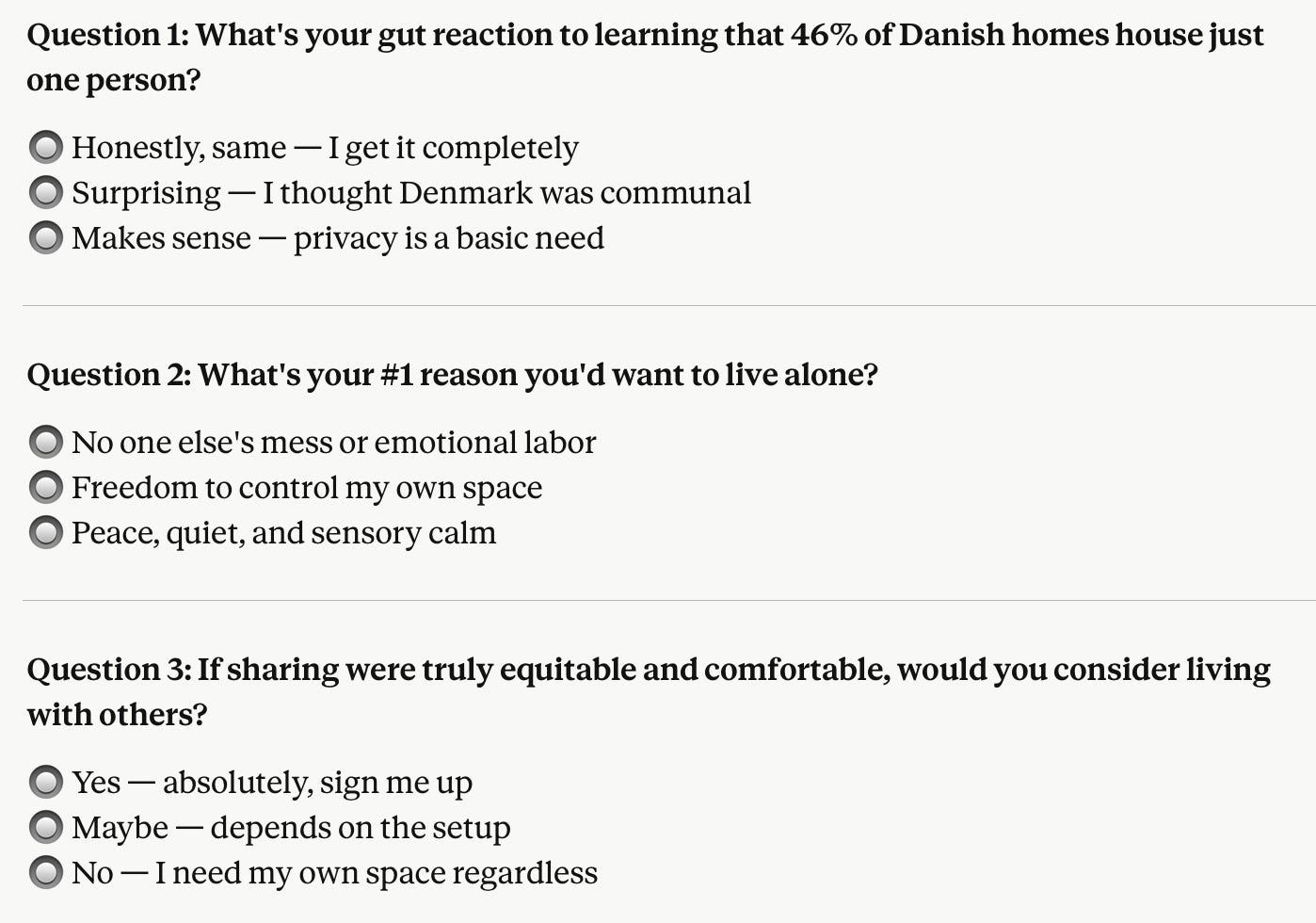
Poll
Post-Episode Fact Check
CLAIM 1: “46% of all Danish households consist of just one single person.” ASSESSMENT: ✅ BROADLY ACCURATE Denmark consistently ranks among the world’s highest for single-person households. Eurostat and OECD data confirm Denmark at approximately 44–47% single-occupant households depending on year and methodology. The 46% figure is plausible and consistent with published statistics.
CLAIM 2: “The study is by a researcher named Tulia Jack, titled ‘Home Alone: Solo Living Pathways, Everyday Experiences, and Policy Implications for Sharing and Sustainability,’ 2026.” ASSESSMENT: ⚠️ UNVERIFIED — TREAT AS EMERGING RESEARCH This study was not verifiable in publicly indexed databases as of the knowledge cutoff. The 2026 date suggests it may be very recently published or forthcoming. The podcast presents it as a peer-reviewed sociological study; listeners should note it has not been independently confirmed here. The qualitative methodology described (in-depth interviews with 23 solo dwellers across a wide age range) is consistent with legitimate sociological practice.
CLAIM 3: “Women in Denmark still perform nearly an hour more of household labor per day than men.”ASSESSMENT: ✅ CONSISTENT WITH EVIDENCE OECD Time Use data and Statistics Denmark confirm a persistent gender gap in unpaid domestic labor in Denmark, estimated at approximately 45–65 minutes per day. Denmark does rank among the EU’s best performers on gender equality but has not fully closed the domestic labor gap.
CLAIM 4: “Solo dwellers in Denmark generate 13 tons of CO₂ annually, versus a national average of 9 tons.”ASSESSMENT: ✅ PLAUSIBLE, CONSISTENT WITH LITERATURE Research on household carbon footprints consistently finds that single-person households have significantly higher per capita emissions than multi-person households due to infrastructure duplication and underoccupied heated space. The specific figures of 13 tons (solo) vs. 9 tons (average) are consistent with the range reported in Scandinavian energy and climate studies, though the exact figures may vary by source.
CLAIM 5: “Single householders have double the average per capita carbon footprint of individuals in households with five or more people.” ASSESSMENT: ✅ SUPPORTED BY RESEARCH Multiple studies in environmental sociology and housing energy research confirm this order of magnitude. A frequently cited study in Global Environmental Change (Ivanova et al., 2016) and subsequent European research support the finding that per capita emissions decline significantly with household size.
CLAIM 6: “Denmark is second only to Sweden in the EU for narrowing the gender gap.” ASSESSMENT: ✅ BROADLY ACCURATE The World Economic Forum’s Global Gender Gap Report consistently places Nordic countries at the top. Denmark typically ranks in the top five globally; Sweden and Finland often edge it out within the EU. The claim is directionally correct.
CLAIM 7: “Eric encountered a viewing queue of 200 people for a single Copenhagen apartment.” ASSESSMENT: ✅ PLAUSIBLE / ILLUSTRATIVE Copenhagen’s housing market is among the most competitive in Northern Europe. Anecdotal and documented reports of large viewing queues are consistent with journalistic and policy coverage of the city’s housing crisis. This specific number comes from a study participant’s personal account and is presented as such.
OVERALL EDITORIAL ASSESSMENT: The episode is well-grounded in established sociological and environmental research. Its primary claims are either verified or directionally consistent with the published literature. The central study (Jack, 2026) should be independently confirmed once available. No significant factual errors were identified. Appropriate epistemic caution is used throughout — the hosts present findings as those of a specific study and invite engagement rather than stating all claims as settled fact.
Image (3000 x 3000 pixels)